By Hannah Deschamps
This sketch is neither a biography or an autobiography, but a combination of both or rather a sketch of family history. I have been frequently asked to tell of incidents from my mother’s life, hence my sketch will center around her life and will branch out to her descendants and ancestors as far as I am able to ascertain.
Mary Jane Jones Evans, the person of whom I have made mention above, was born at Salt Lake City, January 17, 1853, and was the third child of Mary Hughes Evans and Richard T. Jones (Richard Thomas Jones). I will leave our character now for a brief space and tell you something of her parents and grandparents.
Richard T. Jones, her father, was born March 5, 1819, the same year as Queen Victoria, at Llanmorganshire, Cardigan, South Wales. His father, William Jones, was born March 18, 1771, at the same place as was also his mother, Mary Thomas, on January 1, 1763.
While the residence of this family was in Llanmorgan, his parents kept a tavern which was called Cross Hands, hence grandfather was always known as Richard Cross Hands. Richard became a member of the LDS Church while a very young man and while he was not a gifted speaker he was exceptionally good at singing and often accompanied the Elders of the church in their missionary travels, lending his efforts in song, accompanied by John Morris Jones. I have been told by people who knew him at that time that he was a handsome young man. He was tall and stately with large blue eyes and even at the age of 19, his hair was as white and wavy as at the time of his death, which occurred September 30, 1897, at the age of 78 years.
All his life he was a man who had very little to say, and as he did not enjoy very good health, he did very little hard labor but had the ability of taking care of the means he had acquired. Through his frugality and the assistance of an ambitious wife, they left their family at the time of their deaths, in fairly good circumstances considering the hardships of pioneer life through which they passed.
Grandmother, Mary Hughes Evans was born November 8, 1825. She was the daughter of William Evans and Eleanor Hughes, all of Llanbyther, South Wales. Three children were born of this couple but only the two girls, Mary and Rachael survived. When these girls were young, the gospel was being preached to a great extent and through the manifestations which the younger girl, Mary, received, they were converted to the gospel. It occurred in this manner: Their family had frequently attended meetings held by the missionaries but was not convinced that they had the truth. One evening Mary had a remarkable dream. She saw two men who appeared to be flying through space, at least they were above the ground, and one of them offered her a book which was the Book of Mormon. This dream impressed her very much but more so when the next day two missionaries came to their door and one of them held in his hand a book that looked identically the same. This man was none other than Captain Dan Jones who took such an active part in the early history of the church. Soon after this, she and her sister were baptized members of the church, but were strongly opposed by their mother who was greatly prejudiced against Mormonism. As early converts were urged to come to America, they, along with their husbands and babies took passage on the ship Joseph Badger.
Grandmother (Mary Hughes Evans) had just given birth a few weeks before they left for America. Her small baby, Mary Ellen, was only five weeks old at the time. Grandmother has often said this was the most trying time of her life. This small baby cried day and night during the entire trip. This was accompanied with sea sickness and the thoughts of leaving her mother broken hearted and alone not to mention the thoughts of entering a new land. This was almost more than Grandmother could stand. She said more than once that she was tempted to throw herself overboard and end it all, but the encouragement she received from her devoted husband and her abiding faith in God and the restored church buoyed her up. They arrived in New Orleans, November 1850. Then began the tedious and perilous journey across the plains, so familiar to the LDS Saints.
They arrived in Salt Lake City September 27, 1851. While they remained in Salt Lake a little over three years, they had no permanent home. Grandfather worked most of the time for Heber C. Kimball whom he loved as a father and for whom he later named one of his grandchildren. While there, my mother, Mary Jane, was born and they then moved to Brigham City in October of 1854. During their sojourn at Brigham City, the order came from President Brigham Young to move south as Johnston’s Army was coming and threats had been made to completely annihilate the Mormons. It was another trying time for this family, which was continually increasing in number. To pick up and leave their few earthly treasures and flee for safety was very difficult. You can possibly imagine the loneliness of my mother, having learned of the death of her mother, who died of a broken heart after both of her daughters had left. To add to her loneliness, her sister Rachel and family, hearing of the gold rush in California, as did many others at that time, moved their family to California. There they remained a few years, when the father, Benjamin Jones died. Two months later, the wife (Rachel Hughes Evans Jones) gave birth to a baby girl and both she and the baby died and were buried together in California. This left four young children to battle alone in California without kith or kin. The oldest boy, William H. (William Hughes Jones) was only 17 years of age. He assumed full responsibility as father and mother. He huddled their few belongings into a wagon with two span of fine horses. He and his two brothers, Ben and Jedd, and his little sister Mary Ellen, began their long and tedious journey back across the hot desert to Utah. He had promised his dying mother that he would take them back to Aunt Mary or “Nunty” as she was called. By the time they reached Utah, Grandfather was planning on a move further north. When this family arrived, they were received with open arms and they became one big family. Grandmother, we are told, never showed one bit of partiality for her own children, but did as much for one child as she did for the others.
In June 1865, this double family entered the valley of Malad, accompanied by the Thomas Daniels family, Daniel and Benjamin Thomas, and a few others. When they arrived here, there were only five families here. Their homes were on Bannock Street which was then a road through what is now Elkhorn. The five families were Henry Peck, Benjamin Thomas, Bill Williams (who afterwards moved to Montana) and P. Thomas, who also moved away, and a Mr. Caulters (Montana). As soon as the Jones family arrived, they immediately erected a two room log house, directly across the street from Sert Cafe. This house was thatched with wheat grass which covered quaking asp willows. This was all covered with dirt. At that time there was no saw mill so they had no floors except the bare earth. A large fireplace built of rocks added comfort to this humble home. On this fireplace they used a reflector and cooked their food over the fire.
Grandmother had learned the art of making an oven and when her neighbors heard of this, they all tried to bake the same way and have the use of her oven. This oven was built of rock and mortar up to the height of 18 or 20 inches. This was then covered with sand built up in a mound. A coating of mortar was placed over this sand, then another layer of sand and mortar for several thicknesses, then the door or opening was removed and all the loose sand taken out except a covering for the floor of the oven about 4 inches deep. Then a fire was built leaving the door off until the fire was burned out. Bread was then placed in the oven, the door replaced and plastered over with mortar. The bread remained in this oven for one and a half hours and then the door was again opened and the most delicious bread was the result with never a sign of burned crust or under done bread.
The furnishings of the house were very crude. The bedsteads were made of logs hewn down to the required size, then ropes were drawn tightly from one side to the other. Straw or wheat grass ticks were placed on these and at that time were considered comfortable beds. The seats were made by splitting logs and boring holes through them and placing legs through the rounded sides, having the flat side of the slab up. Their cupboards were made in the same order as were their tables and other furniture. Later on when a saw mill was built and operated by John J. Williams, they were able to make many improvements in this humble home.
With the addition of this adopted family and steady increase in their own family, it was found necessary to build a granary, which Grandfather and the boys soon erected. This served as a bedroom for the boys for a long time.
This first home was located on the northwest corner of the property, now owned by my aunt, Mrs. Richard E. Jones, on Bannock Street facing the southwest. Many years later it became my birthplace.
These early pioneers were frequently alarmed by the presence of Indians. Though no serious trouble was experienced, the settlers still lived in constant dread. On one occasion an Indian came to Grandmother’s house begging for food, but just at that moment, my mother Mary Jane, had been bitten by a California spider and so deadly was the poison that it would have taken her life had not this Indian come to her rescue. He immediately bound a handkerchief about her arm, making a tourniquet. With a sharp pointed stick he and her cousin, Bill, went out in search of poison segos. When they returned, the Indian pounded the sego to a pulp and bound it over the wound. In a short time this became black. He then removed this and replaced it with a fresh poultice. It was not long before her arm became normal and the bandage was removed. This Indian was a welcome visitor at their home from that time. He was a brother to Chief Pocatello. Such incidents as these caused the Indians and whites to become more friendly and the people were all instructed to feed them rather than fight them.
They were the parents of nine children: Alexander, Ellen Hoskins, Mary Jane Evans, Rachel Ann Thomas, Richard E. Jones, William E. Jones, Hannah E. Jones, Margaret Hettie Sawyer and David E. Jones. The record of the above will be found on the Family Group Sheet.
I stated before that Grandfather was a weaver by trade. When he was a young man, before he was married, he carded the wool, spun it and wove it into cloth. He then presented enough of it for a dress for each of my grandmother and her sister. I am heir to my grandmother’s dress which (at the time of this writing) is 100 years old. It is as clear and pretty as a new piece of cloth. My grandmother was always proud of this dress and whenever any of her grandchildren pleased her, they were rewarded with the promise of this dress after her death. It finally became my mother’s and she in turn promised it to me.
For many years I lived with my grandparents and loved them very much. Sometimes I believed I was their pet as I was given many privileges that the other grandchildren were never allowed. Grandfather was a good gardener and no one was ever allowed to step inside his garden except Grandmother, But when carrots, turnips, and peas were ready to eat, if I happened along, he would always tell me to slip in and take what I wanted to eat.
Land was plentiful when they first settled in Malad. While part of the boys assisted in farming, the others did considerable freighting. Soon the family was in a position to erect what was at that time considered a modern mansion. That was about 1880. It was built of red brick and is now my mother’s home. Even now, 60 years later, it is in fairly good condition. (Owned now by their granddaughter, Blodwin Thorpe.)
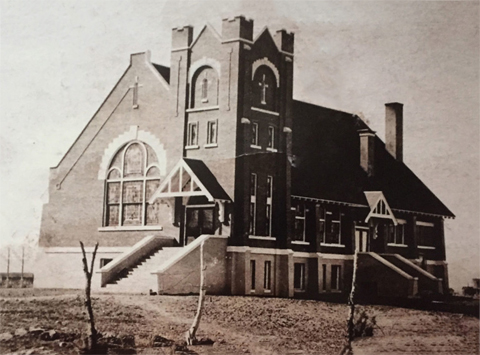
Their home was always open to friends and strangers. They lived close by the meeting house and their home would always be crowded to its fullest capacity at conference time. Beds were made over the floors and quite frequently the table would be reset two or three times. People in those days traveled by team and it was not unusual to see three or four teams unhooked in their yard and they would stay two or three days. People would stay with them from Marsh Valley, from Franklin, Portage and other places. Generally if an Apostle came from Salt Lake City, they made this their home. Grandmother was especially generous to everyone. She could not see anyone in want. She would share with them her last loaf of bread.
These good people were very affectionate to each other and Grandfather always desired that their journey through life would end about the same time. His wish was granted for Grandmother died August 28, 1897, and one month later on September 30, 1897, Grandfather died. Thus ended the career of a noble couple.
History of Richard T. Jones and Mary Evans, His Wife
They immigrated from Great Britain to America October 7, 1850. They first moved from Llanbyther, Cross Hands, Carmarthenshire, South Wales to Swansea by coach. From Swansea to Liverpool by sailing vessel named Troubadaur. On October 17, 1850, they took passage on the ship Joseph Badger and sailed from Liverpool with John Morris as captain. They arrived at New Orleans on November 22, 1850 and took the steamer named El Passo to St. Louis. They remained in St. Louis from December 3 until April 1851.
They bought an outfit for the overland trip and shipped some by boat to Churchville. They commenced their overland trip with the first objective being Council Bluffs, Iowa, on the Missouri River where companies of 50 wagons were organized to cross the plains. They arrived at Salt Lake City on 27 September 1851. They moved from Salt Lake City to Brigham City, Utah or rather the Old Fort in October 1853. They next moved to Malad City, Idaho, in April 1865. The above Richard Jones and Mary Evans died and were buried in the Malad Cemetery.