(Thomas Pierce Family History)
Catherine Peirce was born in Denas, Wales, 26 June 1855. She was the youngest child in a family of eight children. Four boys and four girls. Her father, Thomas Pierce Sr., was born in Wales in 1807 and died 10 May 1863 at the age of fifty-six. Her mother was born in Wales 25 March 1811 and died at Willard in 1887 at the age of seventy-six years.
The family consisted of the following children, William, Edmond, Margaret, John, Thomas, Ann, Mary and Catherine. Ann, Edmond, William and John remained in Wales while Mary emigrated to Utah in the year of 1864, just two years before the mother and the rest of the family. Mary was married to William Bath of Salt Lake City, Utah, a widower, with a large family. She also reared a family and died in Salt Lake City, Utah. After the death of Thomas Pierce Sr., the mother, Margaret, Brother Thomas, sister Margaret and Catherine came to America on the ship John Bright, 1866 sailing vessel. Leaving Liverpool, England on 28 April 1866. They were on the ocean for six weeks and encountered many fierce storms. At one time the Captain of the ship gave up as lost, however they arrived safely and landed in New York in July 1966. Later going to Pennsylvania then to St. Louis, where they stayed three weeks, living in a tent which was made of quilts, which often blew down. Omaha at the time boasted of one store, one butchershop and one blacksmith shop. There they joined a company of saints under Samuel Wight and started across the plains. It took two months to make the trip of 1100 miles, Catherine being only 11 years old, walked the entire distance. They stayed in Salt Lake City for two months and later moved to Willard, Utah.
In Willard Catheirne met Henry Jones and was married 27 December 1875 in the old Endowment house at Salt Lake City, Utah. After their marriage, Catherine and Henry lived in Willard until their first child was born. David H. born 23 September 1876. They moved to Malad, Idaho that fall and settled in St. John where the rest of the family was born. Catherine was the mother of seven children, three boys and four girls, namely, David H., Thomas H., Rachel Ann, Margaret, Mary May, Henry and Rosalie. She was a faithful Latter-day Saint. She worked hard all her life and died in St. John at her home, at the age of sixty-three of pneumonia and heart trouble just the day before the first World War ended on November 10, 1918. She is buried in the St. John Cemetery.
Margaret Thomas Pierce was married to John Edwards, father of David Edward, as was her sister Margaret in plural marriage. Margaret had four children: David, William Kate and Margaret (Rice).
This sketch of Catherine Pierce Jones was written by her daughter Mary May Jones Harris in 1934.
Henry Jones 1909
Newspaper article: Monday November 25, 1918.
(Headshot black & white photo of Henry Jones, located at the top left hand side of the page.)
Henry Jones, of whom the above is a portrait, had been prominently identified with the life of Malad valley from the time he first located here in the early seventies. He was a native of Wales, born at Pencader, S. W., Jan 13, 1849. He had but little opportunity for education during his early life. Like nearly all the boys of his time, he was put to work as soon as he was big enough to do anything. In 1866 Mr. Jones with his parents, immigrated to the country and located at Willard, Utah, where in 1873 he married Katherine Pierce. In ‘76’ or ‘77’ he came to this valley and within a short time bought the farm at St. John where he made his home for the remainder of his life. The lack of education in boyhood made Mr. Jones, a more ardent student in his later life and he acquired a store of knowledge greater and more useful and practical than the average man of today gets with all the advantages of the present-day educational facilities.
We think Mr. Jones’ official career began in March, 1889, as deputy assessor under James Daniels, and later, upon the death of that official, he was appointed to fill out the unexpired term. In 1890 he was elected probate judge, which position he held for four years, and then in ‘96’ was elected as county commissioner. He was again elected to the same position in 1902, and in 1907-8 represented Oneida county in the State senate. He was a careful, conservative business man and it has always been said that he gave the same attention to his official work that his own private business received.
Of this world’s goods Mr. Jones accumulated a good portion, his estate being estimated in value from sixty to ninety thousand dollars. This he accumulated by careful management and hard work, and this shows more plainly than anything else the character of the man who was called to his eternal home on Sunday morning, Sept. 12. He was conservative about everything but once his sympathy was enlisted in any move he could always be depended upon to exert every possible effort to carry it through successfully.
(This note is located below the newspaper article.) Correction: Henry Jones’ father died in Wales. …He and his mother immigrated in 1868. He married in 1875.
Malad, Idaho Obituary. 1918
(Special Correspondence.)
Malad, Idaho., Nov. 22-Mrs. Catherine Pierce Jones, who died at her home in St. John Nov. 10, after a brief illness, was the daughter of Margaret and Thomas Pierce of Glomarganshire, South Wales, where she was born, June 26, 1855. Her father died when she was eight years old, and at the age of 14 she left her childhood home, with her mother, one sister, Mrs. Margaret Edwards, now of Willard, and her brother Thomas Pierce of St. John, and came to America. They crossed the plain in Capt. Samuel Wright’s company, arriving in Salt Lake City, Sept. 5, 1864. Mrs. Jones had walked the entire distance across the plains. They lived in Salt Lake City a short time and then moved to Willard, where she met her husband, the late Judge Henry Jones. She was married in Salt Lake City, in December, 1875. In the fall of 1876 she and her husband came to Malad valley. They settled in St. John three miles west of Malad City, where she had since resided.
She leaves seven children, all of whom are living; they are David H. Jones, Thomas H. Jones of Malad, Mrs. Thomas J. Davis, Mrs. Don Noble, Mrs. Arch Harris, Henry Jones all of St. John and Mrs. Miles Slater of Malad; also 22 grandchildren; one sister, Mrs. Margaret Edwards, and a brother Thomas Pierce.
(A full page photo of the owner in front of his ‘City Meat Market’ store and a gentleman on a horse. The caption says: owner (Dick) Richard in White Coat. Son Henry Jones on Horse.)
Henry Jones & Catherine Pierce Jones
By 1875, Henry had met the fair, young, Welsh lass by the name of Catherine Pierce. They courted, they fell in love, they were to be married. On Christmas Day 1875, Henry was ordained an Elder in the Church of Jesus Christ of Latter-day Saints by William Lowe, Edwin Condon, James Chandler and Abraham Zundel. James Chandler was the mouth piece.
(A photo copy of a written record of Ordained Certificate of Elder. Located in the center of the page.)
It was exciting to travel to Salt Lake City after Christmas and observe all that had occurred in the twenty six years the Mormons had been in Utah. There were, in the territory, about 100,000 L.D.S. members; 200 cities, towns and villages, north in Idaho, east to Wyoming, west to Nevada and south to Arizona. There were schools, banks, factories, mills, hospitals and much to improve and benefit each community. They were charmed by the trolley tracks and cars that were in operation around the city. On temple square they watched the Temple being pushed to completion. They visited the magnificent Tabernacle and saw the famous Organ, boasting 57 ranks and 2,648 pipes, the 12th largest organ in the world. Henry’s near relative, Evan Stevens had written many hymns and was the director of a fine choir there.
The weather was mild that winter with much rain but little snow, however, Henry and Catherine were too excited to see much except each other and on 27 December 1875 they were married in the Endowment House on Temple Square by Daniel A. Wells. Henry was a mature man of 26 and Catherine a blushing bride, age 20.
Trains still interested Henry, and they visited the train station and learned they could travel from Omaha, Nebraska to San Francisco, California, one way for $111.00 in only four days, four hours, and forty minutes. Buffalo and Indians permitting. They had a good laugh, and decided they could use that money for something else.
Back home in Willard, they spent the happy days planning their life. Where would they live? What would they do? And best of all what would they name their first-born child? They decided to become farmers, mainly because they lacked finances to do anything else that would provide a home and a living for the family they planned to produce.
In 1862, President Abraham Lincoln had signed the Homestead Act, which gave to each person 160 acres of land for $1.00 per acre, if he were willing to clear the land, fence it, dig a well, build a dwelling and live there for seven months of the year for five years. Henry envisioned the Malad Valley as he had seen it a few years ago, with its clear streams and fertile soil, and saw the potential to realize their dreams. That summer of 1876, they went to Malad, and after much looking, decided to homestead in the community of St. John. It was 4 miles northwest of Malad, and after much discussion and pondering they chose their spot. Henry, Catherine and Mother Rachel each took out a homestead claim of 160 acres and were able to buy 160 more acres from Will Hill, which gave them a total of 640 acres. Their own section of land. They would make it. They had land, the rest would come.
While Catherine was in Willard awaiting the birth of their first child, Peter H. Illum and Henry began building a house for them on their homestead. For $800.00, Peter provided the materials, built the house, and taught Henry how to build.
On 23 September 1876, Catherine gave birth to David H. and a month later they moved into their new home. Henry, a man of responsibility, provided a little log home for his mother Rachel, over in the field near their home.
On 2 August 1875 the St. John Irrigation Company had been formed and Henry became a stalwart supporter in the company. He wanted anything that would build up his farm, and realized how dependent each member of the new community was on the others. They bartered work for work; horses for a wagon; milk for flour; anything and everything except money. No one had any and there were only about twelve families in St. John.
The Sage Brush was higher than his head and had to be chopped with an axe, then piled up and burned. To clear four acres a year would be good going. A well was a must, fences next, corals to keep whatever livestock he owned–the list of things needed went on and on – Homesteading was not for the fainthearted.
The first thing the next spring of 1877 was to plant a big garden. The winter had been a lean one, and they vowed it would not happen again. A sack of flour cost $1.25; corn meal .75; good wheat was.60 a bushel; and beef and pork were $5.00 per 100 pounds. Henry had saved a little money from the railroad work and they were able to acquire some things from the Edwards farm in Willard and the Stevens cousins who lived nearby. They worked hard through the summer and had storage food for winter.
President Brigham Young died in Salt Lake on 2 September, and they were saddened by this news, but happy with their farm. Little Davie, a year old, was the light of their life and such a joy to old Grandma Rachel, who was now called Mongie (Grandma in Welch.)
The year of 1878 was an eventful one. On 7 May another son was born and named Thomas. Henry studied and practiced his writing until he became a fine penman. He practiced the art of Logographs, which used a symbol instead of a word. (Similar to our present day shorthand.)
A modern day writer, Benjamin Barber, has given us a quote that seems to apply to Henry Jones. “I don’t divide the world into the weak and the strong, or the successes and the failures, those who make it or those who don’t. I divide the world into learners and nonlearner.
There are people who learn, who are open to what happens around them, who listen, who hear the lessons, when they do something stupid they don’t do it again. And when they do something that works a little bit, they do it even better and harder next time. The question to ask is not whether you are a success or a failure, but whether you are a learner or a nonlearner.”
(Picture/copy of Vowell Logographs and notes. Located on the lower half of the right hand side of the paper.)
That year, the men got together with David Saer (Welsh for carpenter) Jones, and built a combination church, school, of logs, 18’ x 30’ with a sod roof, rough sawed floor, and split log seats and benches. Anna Josephson and none other than Henry Jones became the first teachers. He felt a great sense of accomplishment that all his self-education could now benefit others.
(A drawing of a log cabin with a sod roof, located on the upper righthand side of the page.)
In the next five years, Catherine’s brother Tom Pierce, married on 18 December 1879 and settled near them; that winter, many died when an epidemic of Depitheria swept through the valley; 23 January 1880 the Jones had their first daughter and named her Rachel Ann; they planted a ten acre orchard and acquired bee hives to sit beneath the trees. Henry seemed to be in tune with all nature about him and when he robbed the hives of honey, the bees would swarm his arms with layer after layer of bees, yet, they never did sting him.
Henry and Catherine planned carefully for everything they did. The cattle, sheep, horses, chickens, turkeys, ducks and geese, pigs each had a purpose–some to eat, others to breed and build up good stock. They were able to get a Spinning Wheel for Grannie Rachel, and when the sheep were sheared, she corded the wool, spun the yarn and knit useful items. Cattle were selling for $35.00 a head and Henry had a great love of horses. His brother-in-law, Tom Pierce, was an expert horseman, and the two carefully planned and saved to buy big draft horses, and just for fun, some good trotting horses.
(a picture of a man standing holding a draft horse by the holter. Picture is located at the lower righthand side of the page).
They even imported a stallion from the old country, a few years later, that cost $3,000.00. This proved to be a good investment, and many farmers improved his farm stock from Jones horse flesh.
About this time they built another school house. This one was known as the White School, because it was built of white pine lumber. It had store bought seats and two could sit in each seat. All the grades were in one room. What a luxury this new building was to the adults who were eager to have their children learn to improve themselves and for the betterment of the community.
(Pencil Sketch of the School located on the upper right hand side of the page. The heading under the sketch says White School House.)
On 1 January 1883, another daughter was born to Jones and her name was Margaret. Rachel was happy for a sister.
That summer set all the valley back with a severe drought, but there was no turning back and the next year was better. In fact they were all happy when their little L.D.S. Branch became a Ward on 24 August, with James P. Harrison as Bishop.
Their church seemed to be the center of all activity. There they worshipped their God on Sundays, and whenever they could they had a dance. Hop-nailed boots tore up the floor, coal oil lamps lit up the shine in their eyes and between the Church and the Dances, they were lifted up and went back to their homes ready to take on whatever the world handed them.
Mary May came into their lives on 1 May 1885 and they were glad. As the children came, they were loved, taught to love and know the value of work. Each had his job and there were many jobs: water to carry; clothes to scrub; wood to haul and chop to feed the old black cook stove, their source of heat and to cook on; seeds to plant, hoe and water; fowl and farm animals to feed and water; eggs to gather; pens to clean; food to be preserved for winter; meals to prepare; bread to mix and bake; some days Catherine felt she would never get it all done, then she would remember the endless days of crossing the ocean and then walking across the plains and she realized how blessed she was. A neighbor would come to visit, tea and cookies would be served, cares aired, they were renewed and the jobs seemed lighter.
The worst winter in the history of Idaho came in 1886 and two days before Christmas, Catherin bore her sixth child and he became Henry Jr. The snow was roof high and temperatures were sub-zero. They were prepared. Their home was snug and warm and Christmas was a spare but happy day. A few raisins, some homemade candy, socks or perhaps a neck scarf Mongie had knit, or a doll made from a bottle with a little dress on. Some popcorn strings to decorate the tree and of course a sumptuous dinner of Ham or Turkey, all kinds of vegetables, and cakes and pies by the score. They were healthy, happy and together.
That spring, on 19 April 1887, Catherine was heart broken by the death of her mother Margaret Edwards. It seemed they learned each day to take the good and the bad.
Their community continued to grow and on 1 April 1888, Frank Bailey opened a store, and wonder of wonders, a photo studio. Now they could record for posterity the accomplishments of the years–their families. The next year on 20 June 1889, their family stopped growing for a few years with the birth of Rosalie.
(Family group photo located across the bottom of the page. Below the picture says: Thomas, Mother Catherin, Baby Mary Mae, David H., Father Henry, Margaret, Grannine Rachel, Rachel Ann.)
Henry continued to grow in every way. He had a fine wife, who was one of the best cooks in the valley; seven healthy children; his mother was 89 years old and still in fair health; their farm improved year by year; his animals were sleek and fat.
One bad time was when Old Grannie and little Rachel became very ill. Both of them had Typhoid Fever, apparently caused from the barn yards being too close to the well. For twenty one days, fever raged through their bodies, and all little Rachel’s hair came out. Whether she would live was a question. Only Dr. Morgan, who came through the snow with his team and sleigh, Father Henry, and John James’ wife, Hannah, who left her small baby at home, and trudged through the fields to care for them each day, were allowed into Grannie’s little home. Finally the fever broke, and gradually life continued on, the more precious for the near loss. Rachel’s hair grew back in.
Henry patted his enlarged girth. He was a big man, weighing 350 pounds, his chest measured 52”, but he was pretty nice looking, or perhaps distinguished would be a better word. He had black hair, gray eyes and thought perhaps a mustache and a few chin whiskers were befitting a school teacher and a prosperous farmer.
In 1874, a new Oneida County Court House had been built at a cost of $12,000.00 plus donated labor. They were so proud of this building which over-looked Malad from a little hill right in town. Henry thought this would be a nice place to work.
In March 1889, Henry became a deputy assessor under James Daniels, and later, when Mr. Daniels died, he was appointed to finish his term.
On 25 June 1891, he became Probate Judge of Oneida county and held this position until 4 June 1894. He had been right, the court house was a nice place to work.
(Photo of the courthouse. Located on the lower right hand side of the page. The heading says: First Oneida County courthouse, 1874.)
On 3 November 1896, Henry was made Chairman of the Board of County Commissioners. However, all was not well. In 1885, the Idaho Territorial Legislature passed a law continuing the “Idaho Test Oath,” which disfranchised all members of the Mormon Church for even belonging to an organization that condoned Polygamy. Members could neither vote, hold office, nor serve on a jury.
At this time, Henry felt he could best serve his family, his community, and the Idaho territory by being a public official. In 1902, he was again elected as county commissioner. In order to serve it was necessary for him to apostatize from the Mormon Church.
Henry thought of his family and as he drove his team and buggy home from Malad one day, his mind dwelled on each of his children. The two older boys were a big help with the farm, and it was their job to water the trees he had planted all the way around his 160 home farm.
The girls were now helping their mother churn butter and make cheese, enough for their family and some to sell. In fact, they were producing quite a bit of surplus and were able to sell vegetables and fruit, honey, and of course, their farm crops of oats and wheat which had to be hauled by team and wagon to Collingston, Utah to the railhead. He would be glad when the tracks reached Malad.
At home the children ran to meet him and tell all the tales of their adventures during the day, even crying anew over a fall that morning so father could pat their heads and say “Wella Sesia” (all is well” in Welsh) and sure enough it was. Since Mongie could not speak nor understand English, only Welsh was spoken at home and the children found it very hard to learn any other language for school.
He remembered, with a smile, the day he came home and found all the family in tears. Many of the fowls were laying prostrate about the yard, not dead, but scarcely moving. After much investigation and many questions, it was decided the children, at Grannie’s instructions, had fed the fowl the grain she had been fermenting for some home brew. They were not dead, only drunk and passed out. What a laugh that experience was for years to come.
How proud they were when Henry became the Superintendent of Oneida County Schools. He was a man well aware of the needs and problems of each school in the valley.
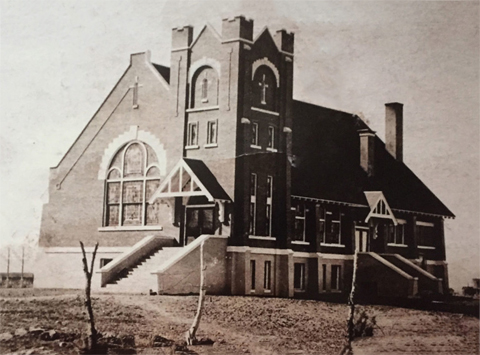
The community proceeded to build a new building of concrete blocks which would serve as a school for the older children, for Church meetings and social affairs. It was entirely built by donation labor and $1,319.10. Some gave .75 and others $75,00, thus making it “their church, dedicated to the Lord.
Two pictures of churches on the right hand side of the page. The top one the caption says: The old St. John ward chapel built between 1896-1897. The second church caption says: Old St. John ward chapel showing the pillars. In the center is a page about the complete cost of St. John Ward cement Church 1896-97
(Hand written note: recorded below)
Expensedages:
Building $1144.66
Land $50.00
Painting Roof 24.40
East Lake windows case 12.50
Stand 8.50
Orbits washing 5.40
Bench logs 6.00
Paid c-op for out lumber & nails. 12.55
Lamps 11.75
Stove 14.70
Recovering deed 1.75
Interested 16.00
Oil, chalk misc 11.20
1319.10
As always the good and bad seemed to balance out. On 21 January, Dan S. Jones opened the Bon Ton Saloon, and their oldest son Davie married Margaret Davis on 27 September 1899.
(Two headshot photos in the top center of the page, one of a lady with the heading saying, Maggie, on the left side of the photo. And the next photo is a gentleman with a heading saying, David H. Jones on the right side of the photo.)
Through the years, the old Grannie Rachel had been a part of their lives. The men had moved her little house from the field closer to their house and the children took turns staying with her at night. They loved to watch her spin on the Spinning wheel, help her dye the yarn into many colors, and watch her flashing knitting needles as she knit their stockings. What a blow it was when she was no longer able to wash and mend for them. It had become a custom since they could walk, that each child had two pairs of stockings. Every Saturday night, they went to Grannie’s house, put their dirty socks in the wash boiler, and were issued a clean, mended pair. Sometimes they were of a solid color, other times multi-colored stripes, but always clean and warm.
The night of October 14, 1899, her grandson Henry, who was thirteen, was spending the night with her, but Grannie was restless and kept fussing. Her legs were so swollen, they were shining and the doctor had told them her heart was not in good working order. It was thought she could have a disease called Cancer. Finally, Henry went to the big house to get Maggie, who was sixteen, and Grannie’s favorite granddaughter. Maggie came, gave Grandma a drink of water, crawled into her bed, held her hand and soon both were asleep. In the morning, Grandma had quietly gone to live with her Heavenly Father and her other family members who were waiting for her. A void was left in their lives no one could fill.
A sad notation from Henry Jones’ Journal:
Rachel Jones, My mother died October 15, 1899 at 6 o’clock a.m. Salt Lake Time at St. John, Oneida County Idaho and was buried at the St. John Cemetery (in her 95th year).
On Valentines Day 1900, Catherine mourned the loss of her beloved sister Mary Pierce Edwards, who was only 49 years old.
Henry definitely lost the popular vote among the women of St. John one Fourth of July
when they put him in charge of the refreshments. All had donated money, only to learn he had spent most of it on barrels of beer. However, the 4th and 24th of July were the highlights of the year’s entertainment, beginning with a parade led by the St. John Band, consisting of some 20 members under the direction of Thomas S. Thomas. Hay racks were decorated with crepe paper streamers (a mess when it rained), horses were groomed and costumed patriots marched proudly along, cheered by half the people in the valley. There were races for the children and everyone who had a bit of good horseflesh were anxious to show off in a race or just some fancy riding. A bower was built of willows where talks were listened to, poems appreciated, songs enjoyed and of course the highlight of the day, FOOD, and lots of it. Every woman prepared her special dish and at night there was dancing.
Henry and Catherine now had one of the finest farms in the valley. Along the bench to the
north of the valley, their fields grew and a good crop of grain. All the farmers worked together to do the big jobs such as threshing grain.
(A photo located across the bottom of the page. It shows a group of people around a mound of hay with horses hitched up to a threshing circle with one person standing above the horses with a crop whip.)
In the center of the valley, the 160 acres raised alfalfa and pasture for the cattle, and the
home acreage boasted the orchard; garden; apiary; a dozen milk cows; and the 70 brood mares. The huge draft horses sold for $400.00 a team and were in great demand among the local farmers, since all farm work depended on the horse for working the land as well as transportation.
(A photo of four horses pulling farm equipment in a field with a man manning the
equipment. The photo is located in the center of the page.)
Life traveled smoothly along for the next few years. On 1 July 1902, Thomas married
Lily Brandzeg followed on 20 January 1904 by Rachel’s marriage to Thomas J. Davis.
(a row of 3 headshot photos along the bottom of the page. The first one is a lady with the
heading Lily Brantzeg. Tommy Jones no picture available. A headshot of a elderly gentleman, and the next photo of an elderly woman. Heading says Tom & Rachel Davis.
Always, it seemed to the Jones, the life of their family was tied to the events of the
community. Whatever happened to one, affected the other. On 25 March 1904, all school and church parcels were deeded to the St. John Ward by James P. Harrison, making it a true ward.
On 1 January 1906, a long awaited event finally came to realization. The train came to Malad! What a celebration they had. No more long, hard trips by wagon to haul produce to market or carry many needed items into the valley. The Pioneer Era seemed to have ended for Malad Valley. Many of the men celebrated at the newly opened Ripley and Vanderwood Saloon. Whether that was good or bad depended on the man, and his woman, when he got home.
By 1907, the community was thriving and a general feeling of fellowship was enjoyed by all, regardless of whether they were Danish, English, or Welsh, even the stray Indians were fed and sent on their way in peace.
St. John was proud to have elected Henry Jones as their State Senator for two years. What an accomplishment for this self educated man from a small town in Idaho. In 1904, Idaho had become a state, and the Idaho Test Oath Law was more or less ignored and Mormons were treated as any other citizen. (This law was never actually eliminated from the Idaho Constitution until 1977).
The people were grateful to their neighbors and friends and decided to pay tribute to those stalwarts of the community seventy years and older. In fact, the Malad Stake Authorities requested each Ward honor them with an Old Folks Day and presents were given. This became a tradition in each community, much like a July 4th celebration in the middle of the winter.
The year 1908 was a hectic one. Both Maggie and May were getting married and planned their weddings at the Salt Lake Temple. However, last minute changes decreed that Maggie and Don Noble be married in the Jones Home and Arch and May Harris in the Temple.
It was probably the grandest affair held in their home. They had acquired a pump organ, the house was almost worn out from being cleaned and the wood pile lowered considerably from all the cooking and baking.
It was Tuesday, 11 June and there were lots of flowers gracing the rooms, wedding cakes were decorated and the brides dresses had come from New York City by mail.
That night a reception was held in the church house. Only one thing was missing. Arch and May had missed the train in Salt Lake after their Monday, 10 June wedding, and when they reached Malad the next night, there was no one to meet them. They walked to St. John, four whole miles, and almost missed their reception. Good and bad again.
(Two pictures located ⅓ down the page across the center. One is a headshot of a couple, with the caption that says: Arch & Mae Harris 1965. The next photo is smaller and is a couple with leaves in the background. The caption says: Don & Maggie Noble 1925.)
The summer of 1909 was pleasant. The scourge of crickets and grasshoppers seemed to have disappeared with the coming of the railroad, the Jones Family were happy with their children and grand-children growing up around them. The farm supported all of them.
Autumn came, crops were harvested, leaves softly took on their red and yellow coats and the quiet time came. Henry became the victim of a stroke. To have lived would have meant possible paralysis. Hard work? Yes. To be lame or useless? No. So as quietly as the falling leaves, he too laid down this life for an eternal one, on Sunday morning, 12 September 1909.
These were the olden days, and the body of the deceased never left the home. They were tenderly bathed and dressed in their finest clothes, and then the body was packed with ice from the Ice House found on each farm. Loved ones, according to tradition, sat with the deceased until the funeral, usually the next day or so.
The entire valley mourned his passing. His family were devastated. How could they function without a leader? Who would they turn to for direction?
Bishop Hyrum Monson took charge of the large funeral and the father of the family was laid to rest beside his mother in the St. John Cemetery. A large granite marker was placed on the Jones plot. Engraved on it was this verse.
A precious one from us has gone,
A voice we loved is stilled.
A place is vacant in our home.
Which God alone can fill.
Final entry in Henry Jones Diary. Made by his son David H. Jones, 12 September 1909.
Henry Jones, My father died Sept 12th, 1909. Don’t know the exact time somewhere (between) 12 pm midnight and 7 o’clock am Salt Lake time at St. John Oneida County Idaho, and was buried at St. John cemetery in his 60th year. Born Jan 13th 1849. Placed in this book by his son David.
(a small head shot photo of a gentleman at the end of the above paragraph. No captions.)
Catherine Pierce Jones sat in her home and contemplated her future life. The Jones Estate was estimated to be worth between eighty and ninety thousand dollars. She was a wealthy widow with two children still at home, but she didn’t have much time to think about these things. On 19 September, one week after Henry’s death, Maggie was at home with a severe kidney infection, and a high fever that produced convulsions. The family railed around and tenderly cared for and prayed for her. For all the care Maggie miscarried and tiny baby Ruth was still born and buried beneath the autumn leaves in the fruit orchard. It was a long time before Maggie was well and mother and daughter cared for each other physically and emotionally. Maggie and Don stayed with Catherine for a time, but then left to continue their journey through life.
They need not have worried about the stalwart mother of the family. She had her own horse and buggy and went about her business with the same grit that had carried her across the plains on foot. The grandchildren always kept close track of exactly when she went to town, for they knew when she came home she would have goodies to share with them. Always a bag of Horehound candy, her favorite. She read very little English, and when the local paper, The Idaho Enterprise, came in the mailbox, one of the grandchildren read it to her and they discussed the news and the prices.
There were three doctors in town, Dr. J. M. Kerns, Dr. D.C. Ray, and Dr. W.J. Wright. A corner lot on Main Street, 86’ x 175’ with a 5 room house, including a pantry and closet, was selling for $3,000.00 Outrageous!
T.M. Thomas and Sons Store had ladies waists at half price for only $4.50 and shoes for $3.50. Meat was .12 to .15 a pound; honey 5 gallons for $4.00; salt 2# for .05; soap, 6 bars for .25; full sheets were .49; corn flakes, .10 a box; coffee 1# for .30. A new drink, called Coca Cola was .05 a bottle, and Golden Bliss Whiskey was $3.00 a gallon, delivered.
However, if you were selling, that was another matter. Sheep were .25 to .50, pork was .02 to .03, and beef .10 to .15 per 100#. Or you could sell your eggs for .35 a dozen and butter for .30 a pound. She also learned she could ride from Salt Lake City to San Francisco, California, round trip for $35.00. No thanks there, no more train rides for her. Now what was this, a Gramophone by Little Wonder Talking Machine for $6.50. Yes, she would buy one and record her favorite song, “Little Red Wing”. How Exciting!
Catherine knew one thing, at age 54, she could not care for her large farm.
As the children married, each had been given 22 acres of the home farm where May and Arch and Davie and Mag built homes and began farming.
They began building early in the spring, before the work on the farm began, and were glad of Don’s experience with Peter Illum, so each of them learned a little about building.
(photo of four guys in coveralls. The picture is located on the center, right hand side of the page. The caption says: Don Noble, Stillman Harris, Arch Harris, Henry Jones.)
Catherine was happy when Davie and Mag went to The Salt Lake Temple and were sealed to each other on 26 January 1911. The weather was so warm there was a heavy rain storm, followed by a flood in Malad Valley.
The Jones, had produced handsome men and beautiful women, and Henry Jr. was no exception. He delighted in “running around with the boys” but when it came to girls, that was another thing. His sisters declared he would probably spend the rest of his life behind the cook stove in the wood box (his favorite spot), but on 12 April 1912, Henry came out from behind the stove and married Catherine Evans, built a house on his 22 acres at the top the lane, and began farming also.
(Two headshot photos. First a gentleman, the other a lady. Located across the bottom of the page.)
(A photo of six working men sitting on the ground. Three are leaning against a house. The picture is located in the center, top of the next page. The following paragraph is right after the picture.)
Once again the men of the neighborhood rallied around to help build the house. Curt Nielsen, Tim Woozley, Uncle Tom Pierce, Arch Harris, Henry Jones and Don Noble.
Now only Rosalie (whom their father had called Rogintis and the children shortened to Gint), was left at home. On 11 June 1913 in the Salt Lake Temple, she married Miles T. Slatter and they too built a home on their tract of Jones land.
( Two head shot photos touching next to each other. First is a gentleman, the other a lady).
Don and Maggie were homesteading out west in Holbrook, Tommie and Lily went to Ely, Nevada to work in the Copper Mines, Rachel and Tom took up residency in the Valley only a few miles to the south.
(On the next page, is a photo of a land deed. The caption says: Land Deed given to Rosalie and Miles after their marriage.)
Catherine was alone in the house. Well almost, for the children, neighbors, friends and especially the grandchildren all came to visit often. How the girls loved to spend the night with Grannie, delighting in combing her long beautiful hair and enjoying tea and cookies. They found great pleasure in just enjoying the farm. They rode horses, had swings, swam in the creek and played in the mud. It seemed anything they did at Grannie’s house was more fun than being at home, and how she enjoyed having them there.
(Photo of a Lady, a young man, two young ladies in a carriage with one horse hitched to it. And a young lady standing beside the carriage. The photo is located across the center of the page. The caption says: Henry Jones Jr., Kate Jones, Catherine Jones, Alice Monson, Rosalie Jones.)
World War I seemed far away to all of them until 2 April 1917, when the United States declared War on Germany. President Woodrow Wilson was sending 25,000 men per month to Europe. Catherine was glad her sons were all married and her grandsons too young to be drafted. That same year, Don and Maggie and their four children moved back into the Jones Home.
Even at that, the War Years left sadness in its wake. Influenza ran rampant through the community. All public meetings were banned, and funerals were held outdoors. Tom Thomas would get his piano on a hay rack and drive to the cemetery so the families could have a bit of music for the services.
The dreaded disease seemed to strike every family, and there was no known cure for it. Some recovered, many died. The month of November seemed to be the hardest, and the cold of winter did nothing to soften the blow of losing a loved one.
Catherine felt alive again to have the Noble Family living with her. It was wonderful to have a purpose to each day, to know there was someone to talk to; to cook for; to care for. Even though her health would not allow a great deal of work.
One cold winter day, she awoke with a cold and each succeeding day it was worse. The doctor diagnosed it as not just a cold, but Pneumonia: (probably congestive heart failure.) More than her feeble heart could handle, and on 10 November 1918, Mother Catherine left the snow and cold of winter for the shelter and warmth of her family in Heaven.
(Three headshot photos of Ladies (Catherine Jones?) plus a newspaper clipping of an obituary of her.)
Newspaper clipping: Malad, Idaho. Obituary. Monday, November 25, 1918.
(Special Correspondences.)
Malad, Idaho, November 22-Mrs. Catherine Pierce Jones. Who died at her home in St. John November 19 after a brief illness was the daughter of Margaret and Thomas Pierce of Glamorganshire, South Wales, where she was born, January 26 1855. Her father died when she was eight years old, and at the age of 13 she left her childhood home, with her mother, one sister, Mrs. Margaret Edwards, now of Willard, and her brother Thomas Pierce of St. John. and came to America. They crossed the plains in Capt. Samuel Wright’s company, arriving in Salt Lake City, September 5, 1868. Mrs. Jones having [had] walked the entire distance across the plains. They lived in Salt Lake City a short time and then moved to Willard, where she met her husband, the late Judge Henry Jones.
She was married in Salt Lake City, in December, 1875. In the fall of 1876 she and her husband came to Malad valley. They settled in St. John three miles west of Malad City, where she had since resided.
She leaves seven children, all of whom are living: they are David H. Jones, Thomas H. Jones of Malad, Mrs. Thomas J. Davis, Mrs. Don Noble, Mrs. Arch Harris, Henry Jones all of St. John and Mrs. Miles Slater of Malad; also 22 grandchildren, one sister, Mrs. Margaret Edwards, and a brother Thomas Pierce.
The next day, the Armistice was signed, ending World War One. The children wanted to keep the Jones Farm intact. It couldn’t happen. The farm was divided seven ways and each child received a cash settlement of $7,000.00. Maggie had cared for their mother and received the home as her portion.
Our portion is life, the memories we hold of their hard work, and the good example they left as a heritage for us to follow.
Prologue
Ardis Whitman, in her article You Must Go Home Again, states, “To know where I came from, is one of the great longings of the human heart. More than genealogical data, we seek in the lives of those who went before us the meaning of our lives. Roots, the dictionary says, are “an underlying support.” To be rooted is “to have an origin.” We need that support, that origin, so the winds don’t bring us down so fast. Our roots are our connection with the generations that proceed us, and thus with the teeming life of the planet, with the continuity of all who live on the earth.
The renewal of memory makes our lives human again–to find in the past, the answer to the present.”
The Jones Home became an ancestor-sheltered homeland to all of us for 101 years, from 1875 to 1976 (when Uncle Don Noble died). We still long to go there, if only in our minds.
Compiled by Betty J. Richards
A granddaughter
18 June 1992
(Two photos on the bottom of the page. The first photo is of a house. Caption says: The Jones Home. The second photo is in front of a house with a couple standing by the steps going on to the porch. The caption says: Don and Margaret Noble.)
Catherine Pierce
Catherine was the baby, at eight years old, she was still the baby, but that didn’t mean she couldn’t help. Her sister Mary always let her help. Today she had helped peel the vegetables and got to dump them in the Cawl. She loved soup made from broth and vegetables. Mother was making Laver Bread from seaweed and oatmeal. It had been father’s favorite, that and a leg of lamb, but now he had died. What would they ever do without him? Once he had been an Inn Keeper, but then he worked as a railroad man. He had died at Baileys Row in Yatradyfodwg, wherever that was in Wales. She didn’t know why. People didn’t tell children those things even when they were eight years old, but she missed him.
Her brother Thomas came home, how she loved him, perhaps he could be her father, after all he was fourteen and his birthday was only one day after hers. She liked his light brown hair, (hers was almost black), but they both had blue, blue eyes like the sky, mother said. Mother was so sad all the time. She still hoped for word from her son John who had gone to America, but no word ever came. William had died long before she was born, Anne and Edmond had their own places to live, so there were just the two older sisters Margaret and Mary and there was Thomas who Mother said was now the head of the household.
They lived in Denas, Llantrisant, Glamorganshire, Wales. John had taught her that. She liked her home and friends and planned to always live right here.
However, two years later, they lost Mary, when she was only 13 years old, her dear Mary had gone to America with a new religion called Mormons. She had sailed on the sailing ship John Bright, and Catherine knew she would be lost like John and they would never see her again. How she cried when Mary left.
However, one day they finally received a letter from Mary and she was safe in Salt Lake City, America. Catherine was so happy, she cried again.
Mother Margaret had listened to the Mormon Missionaries too, and believed their teaching, and they gained a testimony of that religion. They were baptized on 19 November 1863. The family wished they could go to America too, and soon a way was presented to them. The Perpetual Emigration Fund had been established and Saints donated money to bring those from other countries to Utah. Another reason to be thankful they were Mormons. They too would go to America.
Ann and Edmund would stay in Wales, but wished them well, all their friends and neighbors waved them on and they were off to Liverpool, England on a train.
Everything had happened so fast Catherine could hardly believe it, but her youth made any new adventure exciting and she gazed enthralled at the mountains, lakes and rivers of Wales, only a little sad that she would never see them again.
On Monday, 30 April 1866, the Ship John Bright, the very same one Mary had sailed on, left Liverpool. The passenger list recorded: 447-England; 42-Scotland; 250-Wales; 8-American. This broke down into 597 adults; 118 children; and 32 infants. Of those were Margaret Pierce-age 54; Margaret Pierce-21-spinster; Thomas Pierce-16; Catherine Pierce-11. The ship John Bright had been built in 1864, and weighed 1,444 tons. Built for Cooks of London, the ship’s master, Captain Dawson, for Brigham Young Jr. If they had made a mistake, 746 others had done the same thing. Catherine had never seen so many people, and she clung tightly to Thomas’ hand. How could this ship carry all these people so far? Everything was strange. Nothing they had told her prepared her for this!
The ship, she was told, was named for John Bright, a prominent member of the House of Commons of that day. Their leader on the ship was a Mormon Missionary named Collins Moore Gillet. By 4:00 that afternoon, the huge sails caught the wind, puffed out, and they were on their way.
(A medium size photo of a ship sailing on the sea, located on the right hand side of the page).
By May 3, the excitement had dulled. Everyone was sea sick from the rocking of the ship and a hail storm had made it worse. But soon they were feeling better. Once she ventured up on deck, only to be splashed with a wave of sea water, and Mother wasn’t too happy with her wet clothes.
Each of them had to help with the cooking and cleaning up for their own families and all ate together on long tables. It didn’t take long to learn how to hold on to their plates as they ate, or the rocking of the ship would send the food to the other end of the table, or worse on the floor. Some days they could hardly stand up and Catherine’s new-found friend, ten year old Harriet Clark from England, fell and hurt her leg quite badly.
(A picture below the deck of the ship. Shows people sitting at rows of table benches, eating. And Sleeping bunk beds along the sides of the ship. Located at the bottom right hand side of the page.)
Every day, Harriet’s mother Caroline Clark, wrote in her Diary. Even with 8 children to care for she always managed to record the events of the day.
Catherine never forgot the night of May ll. The sea was so rough, and when that happened, the hatch was closed and they were locked in. They had to cook their meals below deck, the smoke made it hard to see or breathe and some of the children had a blight on their eyes. They kept falling out of bed, boxes and tins were sliding about, slop buckets spilled, everyone was sick and the smell and mess were most frightening. The storm continued all the next day and many prayers were said. Mother said it would keep them all humble.
Finally the storm passed and it seemed so good to get up on deck where there was clean fresh air. That night they had music and dancing. What a blessing it was to be able to have music. Catherine was so pleased her Welsh heritage had always fostered music and poetry too.
When the sun showed it was so beautiful to see the sparkling waves, and the sunsets were breathtaking, but it seemed every other day was stormy.
What a fuss it caused when some of the children awoke coughing and soon half of them had Whooping Cough. They coughed until it hurt. Three babies had been born too, but no one had died.
Catherin had gotten used to the rain and wind, but then they had to endure the horrible, raspy voice of the fog horn. Even on deck they could hardly see the big whales through the fog, or the first sight of land at an island called Newfoundland. Finally on the last day of May, they were so close to land they saw many fishing boats, but it was so cold they thought it must be winter. June brought some warm days, but along with them came an epidemic of Measles. One thing for sure on the ship, they shared. What one had they all had. However, they all worked hard to clean up their quarters so when the inspector came on board, everything would look nice, and it did. They were sure some would be held back because of the Measles, but the doctor took little notice of any of them, so they all passed through first rate.
Soon a little tug boat came and towed their ship into New York Harbor. Catherine had never seen anything so grand. Even Thomas was quite speechless and for a Welshman, that was amazing.
Finally, at noon on 7 June 1866, they were once more on land–but just sat and waited. A few of the people ventured into New York and bought bread and cheese, and two girls Catherine had met on the ship bought huge hats. Then they all walked two miles to a steam boat and had to sit there all night. How tired and uncomfortable they all felt, and wondered if they shouldn’t have stayed in Wales and been asleep in their feather beds.
Daybreak they were hurried off to the train for an all day ride that was tiresome but the train went much faster than those in Wales. They were amazed at the uncultivated land as far as the eye could see. All day Thursday, June 8 and for the next seven days, they rode the train into Canada even, and Catherine was so frightened when soldiers stopped the train and searched everyone for firearms.
In a town called Montreal, they changed trains and were so sad when the cab man, Mr. Wheeler had an accident and they cut his foot off. It was terrible.
Now the countryside looked more like home. There were beautiful waterfalls, and the people they saw were dressed so fine, but they thought it strange their homes were built of wood instead of stone as they were in Wales.
On the 11th they crossed a river back into Michigan, United States. On the 13th a man named Mr. Cox died and the next day Harriet Clark’s baby sister died, she had been ill the whole trip. Her father took her body off the train to bury her, and would catch up with his family later.
From Chicago, they went to Quincy, Illinois and it seemed they changed trains every day. Their next stop was St. Joseph, Missouri. They stayed there for a whole day and a night. Catherine hoped they would not ride another train. They were dirty, rough and noisy and there wasn’t much to look at. Some of the children were still getting measles. On June 16, they were taken to a boat and up the Missouri River. Thomas could not believe how muddy the water was and how treacherous under currents there were, but what scared all of them were the Indians who watched them from the river bank. Night came and their beds were made on the top deck of the boat. It was so peaceful to lay there and see the moon and stars shining down on them. Suddenly Catherine saw a little spark, then another and another. They didn’t go out, they just floated around in the air. The girl next to her said they were fireflies. What strange, new things she saw everyday.
The days were now hot and everyone ended up with sunburn. On June 19, the boat docked at Omaha, Nebraska and teams of oxen came with wagons, took all their luggage to a grove of trees and they made tents from quilts for the night. However, the weather did not cooperate and a thunder storm soaked right through. They all ran for shelter in a shed and there they stayed.
(A picture of a large tent made of quilts, with a couple of small canvas tents and a wagon team in the background. Picture located about the center of the page).
Each succeeding day, more wagons came. Finally, on 11 July, the wagons began moving out. They were in the Samuel Wright Company. It was very hot and travel was slow. Catherine was glad, because she had never been so tired nor her feet so sore. On July 22 they reached the Platte River, where a girl who could neither speak nor hear died and was buried beside the trail. On the last day of June, two more people died. Catherine marveled at how strong the people were, to just keep on traveling when they were so sad. Mother said the good Lord took care of his own, and once again they were comforted by the songs they sang and the humble prayer meetings that were held.
The nights there were dancing were the best. Some of the men had fiddles and squeeze boxes, and no matter how tired, everyone joined in the dancing, singing or hand clapping.
On 1 August, they bid goodbye to the soldiers camped by the river and hoped the Indians would not bother them, but crossing the river was dangerous too. The water was deep and the wagons were wet up to the tops of the wagon box, but their wet clothes soon dried out. The trail led them up and down mountains that made Catherine glad she was walking, for only the very old, very young, or the ill, were able to ride in the wagons. The trail was so rough and steep Catheine marveled the oxen and wagons ever made it without an accident.
In one month’s time, she had walked farther than she had ever been in her life. Her body was brown and strong and her feet didn’t hurt anymore. Sometimes, when they stopped for the night, she and the other children played for hours. However, they always stayed inside the circle of wagons, and on 18 July, they were just starting their supper when the alarm sounded. Indians had been following them all day and drove off 91 heads of cattle and wounded 3. The men and boys saddled up and perused them.
(A large picture of the wagon train in a circle. The caption says Wagon trains at Independence Rock. The Sweetwater River is seen at the left. From a painting by W.H.Jackson. The picture takes up more than half the page.)
August 20 was a sad day, they learned from some soldiers that the same Indians that had stolen their cattle, had killed two families and burned their homes. That day Collins Moore Gillet, who had been president of their company on the ship, died. He was so young and highly respected by all.
Four days later four of their men rode in with the stolen cattle. Later in the day a messenger arrived with news that Brigham Young was sending mule teams and supplies to help them. Being young, Catherine thought they had it pretty nice. They had plenty of flour and bacon, some dried apples, oatmeal and rice. They learned to make sour dough bread and some pudding using the berries they picked along the trail. Sometimes, Thomas caught a fish, or someone gave them fresh meat they had killed. The one thing that made all of them cautious were the Indians. Therefore the wagon train had guards front and back, and everyone else was watching for the Indians to come back.
Each day brought new and interesting things, even the animals were strange. Sprightly Antelope, a rodent called Prairie Dogs, and big, shaggy Buffalo.
(A picture of three cowboys hunting down three buffaloes. Picture located in the center, towards the bottom of the page.)
On 29 August they could see the mountains ahead with snow frosting the tops and the cold became severe. The mule teams from Salt Lake met them and brought provisions, then went further on to where some of the companies were waiting for their help.
Catherine decided if she could endure this, she could probably endure most any hardship that came into her life. She was glad their family had made it this far without anyone being sick or dying on the plains as so many others had.
(A map of the United States with the route the group had traveled. Written on the side says: Route of Margaret’s trip across the United States to Utah-1866. The map takes up the whole page.)
By 9 September they had gone over South Pass and now were only 100 miles from Salt Lake City. That was nothing. They had already walked 1,000 miles. Once off the mountain top the weather improved.
They began seeing other wagons and soldiers along the way and it was so exciting to know that soon their journey would end and at long last, they would be in Salt Lake City, Utah.
(picture of a wagon train with a woman walking holding children’s hands and a dog beside them. Located on the upper right hand side of the page.)
On 23 September, Harriet’s brother Frank died. Catherine was so sad. The Clarks had endured continual sickness and two deaths on the journey, and soon Mrs. Clark would have another baby, but she never complained.
When they reached Salt Lake City, they felt the long journey was worth it, it was so beautiful. Not as big as New York, but so clean and new. Everyone was so kind to them and they were happy they had come. Catherine was too young to worry about how they would live, for Mother Margaret had become quite proficient as a Midwife, and Catheirne was too excited to see Mary again. Mary could scarcely believe this mature looking, hardy, brown, young lady was her baby sister.
Two months later, on 24 September 1866, Mother married John Edwards. He was a nice man, and it was good to have a home in Salt Lake City. One year later on 23 November 1867, Catherine’s sister Margaret married the same John Edwards. Catherine had a hard time understanding this, but at the time the Mormon Church believed in plural marriage and it was alright for a man to have as many wives as he could support. They all moved north to Willard, Utah to his farm.
Thomas was 17, and was now called Tom. He worked in the mines of Little Cottonwood Canyon, and on the Edwards Farm for his mother and sister’s husband. Then in 1868, he went to work for the railroad laying track. One of his good friends became Henry Jones, another Welshman, and Tom thought he should introduce him to his sister Catherine when she was a little older.
The family never tired of listening to Tom tell of his adventures on the track and the exciting day of 10 May 1869, when the trains from the East and West met at Promontory Point west of Salt Lake and a transcontinental train could travel from the Atlantic to the Pacific Oceans.
“What was it the Engines said, Pilots touching, head to head? Said the Union, ‘Don’t reflect, or I’ll run over some Director.’ Said the Central, ‘I’m Pacific, But when riled I’m quite terrific. Yet, today we shall not quarrel, Just to show these folks this moral: How two Engines, in their vision, Once have met without collision.’ That is what the Engines said, ‘Unreported and unread; Spoken slightly through the nose, With a whistle at the close.’”
(Photo of a train and railroad. Located on the right hand side towards the center of the page, with the above paragraph on the left hand side of the photo.)
Catherine found pleasure in her new home. She had her mother and Sister Margaret, but sometimes, it was funny when John Edwards called “Margaret” and two women answered. Catherine became the Aunt to her sister Margaret’s children. Her mother was a mother and a grandmother to them. What a funny situation.
Catherine continued to learn the trade of homemaker. There was always lots to do on the farm and it prepared her for when she too would be a wife and mother. It wasn’t long before Tom was working the Edwards farm on shares with his step-father.
They were all happy to have Mary become the bride of William Bath on 9 April 1872 in Salt Lake City. Catherine was a little concerned over the fact that Mary, only 21, had married an older widower who had several children. But like Mother and Margaret, the choice was hers to make.