In Memory of Earnest W. Jones (“EARN”)
(Newspaper article, October 9, 1919)
The only boy from Malad who was called upon to pay the SUPREME SACRIFICE in the WORLD WAR.
Killed in action in the Battle of the Meuse-Argonne, Oct. 9, 1918.
Headshot photo of “EARN” .
Earn was a boy we all adored,
A son of the brazen West,
Who lived for the world as he died for the world.
Giving his all, his best.
His mission with men was to smile and cheer.
Which he did in a manly way.
Wherever he went his soul was bent
To scatter a smiling ray.
Though his duties at home feign would bid him stay,
In this struggle ‘tween wrong and right.
Few days had past until he had cast
His lot in the thick of the fight.
So forth he went with that self-same smile.
With his country’s noblest men.
And smiling, he said, as he raised his head:
“Don’t fret, I’ll return again.”
But the war raged on, and the German hordes
Pressed the allies more and more;
‘Till every advance on the fields of France
Miles of allied trenches tore.
But all at once some unseen power
Swooped down on the ravaging Huns,
And turned them back o’er their shell torn track
At the mouth of American guns.
Behind one gun that was pointed East
Stood this self-same smiling lad,
With his manly zest afresh from the West,-
The pride of all Malad!
As the cannons roared and the shrapnel burst
On and on he pressed the Hun,
Through the battle’s heat ‘till the last retreat,
Marked the day of a vict’ry won.
But, alas! At the end of this man-made war,
When the fumes had cleared away,
Beneath God’s hand on No-Man’s land
Our noble hero lay.
That self-same smile was with him still,
And the Corporal heard him say:
“Tell ‘em Earn’s all right, and still in the fight.
And still in the fight he’ll stay.”
There, somewhere in France, our hero rests,
Draped in Red and White and Blue,
Only God above can reward the love
That he showed for me, for you.
Whatever the cause of a war might be,
Whatever may be its gain,
Not a story that’s told, nor a nation’s gold
Can pay for one boy that’s slain.
Yes, Earn was a leader wherever he went–
At home as well as away;
So nothing would do but to see it through,
To push to the front and stay.
Wherever he is, he’s doing God’s work,
And it’s not on No-Man’s Land;
He’s somewhere above ‘neath God’s own love,
Directed by God’s own hand.
Every thought of Earn is a thought of joy,
Of his vigor, his manly air.
And though he’s gone, that smile lives on,
Forever, God bless him there!
By Thomas R. Rees.
Body of Ernest W. Jones Will Arrive at Hoboken Thursday
He Was the Only Soldier from this Town Who Was Killed in the World War
(From THE IDAHO ENTERPRISE, Wednesday, October 5, 1921)
D. W. Jones received a telegram Wednesday that the body of his son, Ernest W. Jones, who was fatally wounded in France, Oct. 9, 1918, would reach Hoboken, N.J., Thursday, Oct 8. Just what date it will be shipped to Malad is not known.
Ernest W. Jones, who made the supreme sacrifice in France, was the fourth son of Mr. and Mrs. D. W. Jones, of Malad. Ernest was born at Cherry Creek. February 3rd, 1895; and lived there continuously until his parents moved to Malad.
He was strictly a home boy, energetic and industrious, performing the labor of a full sized man from the time he was fourteen years old. He was much admired by all who knew him for his cheerful, open-hearted disposition.
He attacked every duty, great or small, readily and courageously. He took an active part in public amusement and was especially successful in athletics – wrestling, running, jumping, basketball and baseball.
This training made him a fit and ready soldier. So fit, indeed, was he, that in less than three months from the date of his enlistment, he was in France ready for the first engagement.
Two months prior to his departure in the service, Ernest was married to Miss Sylvia Jenkins of Malad, who was loyal, true and devoted companion. She is bearing her loss with courage equal to that of anyone on the battlefront.
Ernest [was] fatally wounded at the battle of the Argonne-Meume, October 9, 1918.
ERNEST JONES GIVES HIS LIFE FOR COUNTRY
Makes The Supreme Sacrifice On The Battlefields Of War-Torn France
IDAHO ENTERPRISE, December 19, 1918
Ernest W. Jones made the supreme sacrifice on the Battlefields of France on October 9th – gave his life in the great struggle for freedom.
The report of his death was received by his parents Friday morning, and seldom have the expressions of sympathy and regret over a demise been so general as those heard that day. The entire community was filled with gloom and sorrow.
Ernest Jones was the son of Judge Dave W. Jones and wife. He was born at Cherry Creek on February 3rd, 1894. He was married to Miss Sylvia Jenkins, daughter of Wm. Jenkins, on August 1, 1917.
Ernest left Malad with the contingent that went to Camp Lewis on Oct. 3, 1917. He landed in England on December 25, 1917. He was a member of a Machine Gun company at the time of his death.
He was an industrious and capable young man, and exceptionally popular among his associates. His life has always rung true. He has been clean, pure and underfiled.
Those who know Ernest’s sterling qualities feel certain that he was the peer of the bravest of those who won immortal glory on the battlefields of France.
We know that he was their equal in all those manly qualities that won for the American soldiers the admiration of the world.
The last letter received from Ernest was written on the 27th day of September, and was as follows:
France, September 27, 18
Dear Folks: I received a letter from you on the 17th and one from ma night before last. I was very glad to hear that you were all well.
I received the pictures you sent me O.K. They came thru [through] fine and I was sure glad to get them. I think they are good, but a little bit sober, as you said. I thank you a thousand times for them. I wish Libbie had been with you. The fellows here said the other members of the family were better looking than I was. Some of the boys picked Sylvia as my sister and others said they could tell Marie and Merle were my sisters by their bright eyes. They said, “Your mother is a young looking woman.” I said “Yes, for a mother of eleven children and a bunch of mean cusses like myself.” They thought I was fooling for a while when I told them you were the mother of eleven children.
Tell Marie not to get in a hurry to get married as there are about four fellows who want to come home with me and become my brother-in-law. But I guess there is no danger of Marie leaving home yet. I hope not.
I was sure glad to hear that Dave had made good and is going to be stationed in the States. I think one in a family is enough to have over here. I thought all the time he would make good.
I have been hunting two or three times, but it has been a long way from pleasure.
I was very pleased to learn that you were getting along so well with the work, but sorry to learn that the grain was a little poor. I hope you have some good lucerne seeds. Well, I didn’t think that Bill and Dock would be able to do a man’s work so soon. That is sure going some, for kids of their ages. You never could have done the work without them.
If things keep up as they have been lately, I don’t think the Huns can last over six or eight weeks, if that long.
I was glad to hear that Margaret and the big boys were getting along so well, and that all the rest of you were well.
I received a letter from Morg Tovey and the other two boys. I haven’t seen any of the other boys yet.
Well, news is scarce so I will close for this time, hoping that this finds you all well as it leaves me at the present. I remain, as ever, your loving son.
Ernest W. Jones
Ernest is survived by his wife, mother and father, six brothers: Lt. Dave W., Jenkin, Brigham, Lavern, Leland and Ray, and three sisters: Marie, Mrs. William Evans, and Mrs. Warren Jones.
May the knowledge that their fellow citizens honor and appreciate the great sacrifice he has made help to assuage the grief of the wife, mother, father, brothers and sisters. May the thought that his name will ever be held in reverence by a grateful community help to lighten, a little, their great sorrow. May the knowledge that he died a hero and that with heartfelt benediction the people will breathe his name. Be a comfort to them.
Suggestions For Memorial For Oneida Soldiers
The Idaho Enterprise, January 2, 1919
Miss Hattie E. Morgan, who has been actively connected with securing data of Oneida County people who entered the government service, was asked by the chairman of the Defense Council for an expression regarding a memorial. Her communication to the Defense Council was as follows:
Having been asked for a suggestion as to the form in which our appreciation of Oneida’s soldier boys should find concrete expression, I would suggest that the principal requirements of any monument should be appropriateness, beauty and utility, and as comprising all them, a Memorial building boasts every requirement here could be safely kept the records of service, the pictures of our boys, the flags and other mementos which will become more precious as the years go by. It would belong to all the people of the county – could be used for band concerts and patriotic meetings.
I would suggest that not less than twenty-five thousand dollars be raised for this purpose. The county could issue bonds and the tax payers meet this amount, but as this would be a labor of love, and it would be a privilege as well as a duty to give, I think the raising of this fund could be safely left to the people of Oneida, whose patriotism has never been found wanting.
As to location, the triangle at the meeting of Main and Bannock streets, if found to be sufficiently large, would be ideal, and as to the time to begin this work, “lest we forget” let it be now, while we feel the urge – while our hearts are so full of gratitude and admiration for the boys who gave, and the boys who offered their lives on the altar of Human Freedom. We cannot honor them too much nor those relatives in the homes where “Suffering has called to them and courage has replied.” Let us help hold high the torch of freedom, and like a rallying call to duty comes the words of a soldier who soon after he wrote them was sleeping beneath the poppies of Flanders.
“To you from falling hands we throw the torch. Be yours to hold it high.
If you break faith with us who die.
We shall not sleep tho poppies grow in Flanders fields.”
Boys From France Arrive Home
The Idaho Enterprise, January 23, 1919
The first contingent of Malad boys who were in foreign service arrived home this week, and as a consequence there is great rejoicing in many homes.
The boys who returned are as follows:
Robert Richards
George Richards
Wm. Jones
Jenk Williams
Dave Griffiths
Victor Evans
Dalam Kent
William Lusk
Orville Bell
Milton Murray
Owing to the quarantine regulations it was impossible to arrange any kind of a public reception for the boys, but no double as soon as the restrictions are removed, the boys will be given a reception that will demonstrate to them the high esteem in which they are held, and give evidence of the manner in which the people appreciate the great cause for which they have labored.
The boys are all in fine condition physically, and have many interesting experiences to relate in connection with the service abroad.
The Service of the Rear
The Idaho Enterprise, May 2, 1918
Ernest Jones sends the following cleverly written poem from France:
When this cruel war is over
And the boys go marching home,
I’m afraid I’ll be an outcast
And forever have to roam,
Whey they show their wounded chevrons
And their services stripes of gold
And they tell admiring lassies
Of valorous deeds and bold,
I’ll be missing from the circle,
And no one there will hear
How I nearly was a hero
In the Service of the Rear.
I am an S.O.R. boy; also an S.O.L.
I never pulled a trigger, or sent a Boche to hell.
I never saw a dug-out, in fact was never near.
For I performed my duty in the Service of the Rear.
When we passed that glorious statue
that our liberties uphold,
We looked upward to the future
With ardent spirits bold.
We prated of Democracy,
And the freedom of the seas,
And how we’d get the Kaiser
And bring him to his knees.
How we’d face the German legions,
Without a trace of fear,
But alas, we had not reckoned with
The Service of the Rear.
For I’m an S.O.R. boy; also an S.O.L.
I never saw a battle nor heard a screaming shell,
The only Hun I ever saw was a Prissonier de Guerre,
A working just like I was, in the Service of the Rear.
I’ve done some Provost duty
Took a turn in warehouse “A”,
Hit up the docks at midnight
When the front was short of hay.
I’ve set up locomotives,
And guarded miles of track,
Chopped wood and dug some ditches,
Just to keep from getting slack.
But tho I’ve done my duty
As I saw it true and clear,
I will never get a medal
For my Service in the Rear.
For I’m an S.O.R. boy; also an S.O.L.
But I’ve always done my duty, and tried to do it well.
So I hope that at the “finl” they will grant my wish so dear,
And let me kick the Kaiser in his Service of the Rear.
Impressive Services for Malad Hero
People of the Valley do Honor to the Memory of Ernest Jones
(The Idaho Enterprise, June 19,1919)
Sunday afternoon the people of Malad Valley assembled at the Second Ward Tabernacle to do honor to the memory of the only boy from this town who made the supreme sacrifice upon the battlefields of France – Ernest Jones. There was an exceptionally large attendance to pay tribute to this young man. People from every section of the county were present. The Tabernacle was filled to overflowing.
An impressive part of the services was the presence of a large delegation of soldiers and sailors, who marched from Bannock Street to the home of Judge Jones and wife, followed by hundreds of automobiles. Cars were provided for the wife, parents and other relatives of Ernest Jones, and the procession, headed by the service men, went to the Tabernacle, where services that will long be remembered were held.
R. J. Harding, vice-president of the Defense Council and chairman of the committee to arrange for the services, presided. Mr. Harding briefly and eloquently explained the purpose for which the people had assembled.
The program consisted of selections by the choir and octet, addressed by E. M. Decker, T. A. Davis, D. P. Woodland, J. Peter Jensen, the reading of original poems by Thomas S. Thomas and C. Hutteballe, an explanation of the service flag and a very beautifully expressed tribute to Ernest Jones by Miss Hattie E. Morgan. The opening prayer was by President Richards and the closing prayer by Robert Jones.
The entire affair was an eloquent tribute to the departed hero, and indicated the high esteem in which his memory is held by the people of Malad Valley, and the genuine sympathy that is felt for the bereaved relatives. Every number on the program was excellent. The remarks of the speakers emphasized the admiration and sympathy of the people of the valley.
The tabernacle was artistically and appropriately decorated. The service flag of the county, which is most beautifully designed, the picture of Ernest Jones, around which an American flag was draped, being important features of the decorations. Many beautiful flowers also added very materially to the appearance of the building.
The crowd that was present, the genuine expressions of admiration, sympathy and respect, undoubtedly will help some to assuage the grief of those who mourn.
In the hearts of the people of Malad Valley, Ernest Jones will ever live. His young life was without stain, and the great cause for which he made the supreme sacrifice, the noble manner in which he acquitted himself in military and civil life, will ever be an inspiration to the people of the county.
Biographical Sketch
The following account of the life of Ernest W. Jones was written by ex-Commissioner W. J. Williams:
Ernest W. Jones, who made the supreme sacrifice in France, was the fourth son of Mr. and Mrs. D. W. Jones, of Malad. Ernest was born at Cherry Creek, February 3rd, 1895, and lived there continuously until his parents moved to Malad.
He was strictly a home boy, energetic and industrious, performing the labor of a full sized man from the time he was fourteen years old. He was much admired by all who knew him for his cheerful, open-hearted disposition.
He attacked every duty, great or small, readily and courageously. He took an active part in public amusements and was especially successful in athletics-wrestling, running, jumping, basketball and baseball.
Two months prior to his departure in the service, Ernest was married to Miss Sylvia Jenkins, of Malad, who was loyal, true and devoted companion. She is bearing her loss with courage equal to that of any on the battlefront.
Ernest was fatally wounded at the battle on the Argonne-Meuse, October 9, 1918.
In addition to his parents and wife, Ernest is survived by the following brothers and sisters: Jenkins W. Jones, of California; Lieut. D. W. Jones Jr. of Nebraska; Brigham and Larson Jones of Cherry Creek; Mrs. W. E. Evans, of Malad R. 2; Mrs. Warren Jones and Miss Marie Jones, Ray and Leland Jones, of Malad.
We know that sorrow of his affectionate father and mother, his devoted wife and the brothers and sisters is being made lighter thru the genuine, true sympathy of all who knew the worth of this devoted son. “Peace to his ashes, rest for his soul.”
To Our Missing Comrade
(By T. S. Thomas)
As we dress up in our uniforms,
Each step we count with time.
There’s a beating in each soldier’s heart,
When we think of that soul sublime.
As comrades we marched beside him,
To fight for freedom and right.
Victory he’s won, his life’s race he’s run,
Now his soul to his maker made flight
His deeds will never be forgotten.
As a husband, a soldier, a friend,
The reward that is promised the faithful
God knows he was faithful to the end.
(By C. Hutteballe)
Sleep sweet beneath the sod in France
You gallant hero from the West,
You toiled and fought for freedom’s chance,
And gave the life that you loved best.
You left your home for Nation’s call
Put on the armour and the sword;
The sea was not too wide a wall,
Nor country’s cause to be ignored.
When war cry, shouts and bombs burst,
You scaled the top, were with the first;
And dangers, fears were all ignored,
When the rifle belched and cannon roared.
Now Saga tells of battlefield,
Of manly deed of heroes dead,
Old glory marks their resting place,
Where flowers sweet the wind embrace.
Sleep sweet beneath the sod in France
Thou noble boy, immortal son,
Your name will live when kindred die
Ye gained the cause, the battle won.
Thousands Pay Respect to Memory of Ernest W. Jones
The Funeral Sunday Was the Largest and most Impressive That Has Ever Been Held in Malad
The Idaho Enterprise Wednesday, October 26, 1921
Another Oneida county hero lies beneath the sod of the country for which he gave his life; another grave that will be decorated and revered by future generations has been added to our cemetery; another shrine where patriotic citizens will renew their fealty to their government and be inspired with loftier ideals has been dedicated.
More than two thousand people paid homage to the memory of this young hero on Sunday. From every portion of the county people came to show respect to this young man who died upon the battlefields of France. It was the most largely attended funeral ever held in Malad. The second ward tabernacle was filled to capacity by a reverent multitude, and there were as many who were unable to get into the building as there were persons inside.
The exceptionally large crowd that was present, the magnificent floral tributes, the reverent spirit that was manifested, must have been a source of satisfaction to the wife, parents and other relatives.
The body of Ernest Jones arrived in Malad Wednesday evening. The remains were met at the depot by a large delegation of ex-service men, near relatives and hundreds of citizens. From that time until the body was lowered in its final resting place it was under guard of the ex-service men.
The remains were taken to the home of the boy’s parents, Mr. and Mrs. D. W. Jones.
The funeral procession formed on Bannock street, went from there to the Jones’ home and then to the tabernacle. It was a most impressive sight.
J. D. Johnson presided at the services. The speakers were Scott Hall, Elias Richards, Senator Harding and R. N. Hill.
Representative Hall said the great crowd was a tribute to the patriotic feeling of this community and an eloquent testimonial of the esteem of the people for the young hero who had made the supreme sacrifice. Mr. Hall spoke words of comfort to the bereaved relatives. He said he wondered if the people of this country were trying to be worthy of the ideals for which Ernest Jones and others gave their lives. Mr. Hall wondered what the condition of the world would be today if men had not been willing to make sacrifices for their fellowmen. From the time of the great sacrifice at Gethsemane to the present time, it has been necessary for men to sacrifice their lives for Christianity and civilization. Mr. Hall admonished his hearers to live for the things that this young man died for. He said his death and the death of thousands of others should bring a better condition in the affairs of the world. He called attention to the disarmament conference, paid a tribute to Senator Borah for his courageous efforts on behalf of that conference and hoped that it would bring about some of the conditions that these young heroes sacrificed their lives for.
Mrs. A. E. Scott, on behalf of the War Mothers, read a poem in a most feeling manner.
Elias Richards said that when the bringing of the remains of the boys to their native land was first discussed he questioned the advisability of such action, but that he was now convinced that it was the right thing to do. He told of Ernest Jones writing to his parents while he was on service behind the lines telling them that he had applied for a position in the front where he could do more for the great cause for which the allies were fighting. This should be the spirit of all of us. Nothing was ever gained in this world without sacrifice.
Senator Harding said he felt grateful for the privilege of paying tribute to Ernest Jones, that he felt honored that the family had deemed him worthy to be one of the speakers. Mr. Harding said it was a wonderful gathering and he hoped it would be productive of good. He told of the manly qualities of Ernest Jones, and his high standing among his acquaintances. Mr. Harding told of his trip to the Jones’ home the day that the message of Ernest Jones’ death was received. “It was the saddest meeting I ever saw,” said Senator Harding. He spoke words of comfort to the parents and wife of the young hero. “That loving companion has touched my heart every time I have seen her,” said Mr. Harding.
The principal address was delivered by R. N. Hill and was as follows:
Brethren and sisters and friends: We are met today to pay a parting tribute of respect to the memory of Ernest W. Jones, a young man born in our valley and who grew up to manhood in our midst: whose life until his country called him, is to us, as an open book, with pages clean and spotless. A young man whose cheerful countenance and winning smile, coupled with his nobility of character, claimed for him the respect, the confidence and admiration of all whose good fortune it was to know him. Born of that good old pioneer stock, the stock that built the bridges, killed the snakes and blazed the trail that civilization might have her abode in the valley of the mountains. A stock that never said “nay” to a duty or turned a deaf ear to the call of the needy. A stock who inculcated the golden rule into their everyday lives and knew no better gospel than to “do unto others as ye would that they should do unto you.” Therefore, when the call of his country reached the ears of Ernest W. Jones, he like 4,000,000 others of our gallant boys, yielded obedience, and like the knights of old, kissed their loved ones goodbye and went to fight their country’s battles and defend their flag against foreign foes.
His early military training was received at Camp Lewis, where for a few brief months, he took the course prescribed for all the troops and so early did he distinguish himself for his adaptability, his eagerness and willingness to respond that his stay at this camp was of short duration and when his call came to leave for France, Ernest gladly responded. Arriving in France, he was assigned to the duties of military police, in which position he gave the best he had and while patrolling his beat, the roar of the cannon, the shrieking of the shells, the passing to and fro of the ambulances, all stirred within him the desire to share with his “buddies” the dangers they were facing, and in a letter to his parents he tells them of his desire; namely, a desire to be in the front ranks; a desire to meet the foe in battle, a desire to place if necessary, his young life on the altar of sacrifice that the world might be made safe for democracy. The next letter to his parents conveys to them the intelligence that he had been rel ved [relieved] from the duties of military police and that his lot had been cast with the 26th infantry, 1st division of the United States army and on the night of July 16th, 1918, we find him at the front before Solssons. All the movements had been made under cover of darkness. Marshall Foch had perfected his plan for a great counter offensive, the movements into position had to be secretly made over unknown roads, through fields and forests, without a gleam of light, lest the enemy note the movements. To add to their troubles, a thunder storm had soaked their clothing and made the shelltorn roads variable quagmires. The night of July 17th was inky dark and the roads, with hundreds of horses, cannons, motor trucks and tanks, made the progress very slow. The attack was to begin at 4:25 a.m. Not many units arrived into position much before that time, but none was late. Through the shell-torn villages the men wound their way; into the valleys and up the slopes, sometimes tangled in the wire and again, pitching head-long into a shell hole. The French guides led the boys to their places. It was known that the fighting would be desperate as it involved an attack over a rolling country which concealed hundreds of machine gun nests and fortified heights which the enemy had elected to hold. The enemy was flushed with victory and confident of continued success and from the natural strength of his position he believed it to be impregnable. It rested upon the courage and indomitable spirit of American manhood to prove this a fallacy.
The division entered the fight under its new commander, General Summerall. It was sandwiched between the 153rd French division on the left and the veteran 1st Moroccan division on the right. The regiments from right to left were 18th, 16th, 26th, and 28th. Each battalion of the regiment was supported by a machine gun company.
The day broke clear and serene. There had been no warning notes sounded by the artillery. If Fritz heard the rumble of the heavy French tanks as they moved into position, he showed not a sigh. This was to be a surprise attack, the master stroke of the allied commander-in-chief. It was to mark the turning point in a great war.
All troops were in position in time to begin the attack at the scheduled hour. The advance was to be covered by a rolling barrage. When the first gun boomed, the dough boys were up and over ere the shell had burst.
On the nights of July 18th and 19th orders were received to continue the attack and at 5:30 p.m. they jumped off again. Here the ground was rolling, covered principally with growing wheat. The place seemed to be fairly alive with machine guns which were cleverly screened and commanding all approaches. But the American blood was up and no power on earth could stop those gallant boys this time. They fought as they had never fought before and that day took all their objectives.
Of the five days the regiment fought during this counter offensive, the late afternoon of July 19th stands out as the day of days never to be forgotten. Their casualties in the whole regiment were almost 800 men. The 1st and 2nd battalions suffered the most. In the 2nd battalion six officers remained and although they had paid dearly, the cost was not disproportionate to the losses inflicted upon the enemy. The regiment took several hundred prisoners, including a number of officers and a whole battery of 77’s. When night came the boys settled down to await the chow carts. Two days had now elapsed since they had seen them and it was not until the evening of the third day that their craving for warm food was satisfied.
The next morning, July 21st, behind a partial barrage, the brigade advanced. All day long the battle raged but the Hun had lost. Companies and battalions were so intermixed that their identity was practically lost but all realized the necessity of holding that which had been so dearly earned.
The regiment entered the line with 3100 men and 96 officers and its total casualties were 1560 killed and wounded; 20 officers were killed and 42 wounded. All field officers had been killed or wounded and the regiment came out under the command of a captain of less than two years’ experience, and one battalion was commanded by a first lieutenant. The regiment captured 750 prisoners, including 14 officers, and during the five days made an advance of 11 kilometers.
The first division, during these five days, met and defeated 6 veteran German divisions and this victory will be, undoubtedly, classed as one of the greatest battles of the war. It marked the turning point in that great German offensive, and the 26th U.S. infantry was cited for distinguished conduct. In overcoming determined and constant resistance, while sustaining heavy losses and in capturing and holding all objectives assigned to it, in the advance between July 18 and 22, inclusive.
After the rest they had won so dearly and the drive of St. Mihiel, we find Ernest and his regiment, the 2nd division, before the Argonne Forest and at 5:25 a.m., October the 4th, the attack started in a dense fog and while it was still dark. The German artillery fire was heavy. Large machine gun implacements, heavy timber and overgrown with moss and shrubbery skirted the edge of the woods and the toll was heavy. The second day’s fighting, like the first, was vicious in the extreme. The enemy preferred to stand by his guns until killed, never to be taken prisoner or defeated.
October the 6th and 7th the fight still rages. October the 8th and the 3rd battalion, still leading, was ordered to advance and flank hill 272. On the morning of October 9th the regiment changed position and with the 2nd battalion leading, advanced northeast. The enemy artillery fire was heavy, especially in the valleys. Again a hill was the objective. It was another day of fierce fighting, toward the close of which our troops drove the enemy from the hill and dug in for the aftermath that was sure to follow. That night the hill became a seething inferno but the doughboys hung on and again the Hun was out-witted. But alas, this day Ernest W. Jones paid the supreme sacrifice, had given his young and noble life that freedom might live.
For eleven days the regiment had been under fire. For seven days it had advanced against most determined resistance. The division suffered the heaviest casualties of its history; likewise the losses of the 26th infantry were the heaviest. The regiment entered the attack with 3200 men and 65 officers. It came out with 1600 men and 41 officers. The regiment captured 350 prisoners, including one Lieutenant-colonel; a battery of four 77’s and a large number of heavy and light machine guns. The total advance was 7 kilometers during which the division encountered elements of eight hostile divisions. The 26th met with resistance from four of these divisions, two of which were encountered on the same day.
The lieutenant-colonel referred to, after four years of fighting and constant service in his army, was taken prisoner by the first division. Listen to his remarks: “Yesterday I received orders to hold the ground at all cost. The American barrage advanced toward my position and the work of the artillery was marvelous. Following that barrage closely were the troops of the 1st division. I saw them forge ahead and knew that all was lost. We knew the 1st division was opposite us and we knew we would have to put up the hardest fight of the war. The first division is wonderful and the German army knows it. We could not believe that in years the Americans could develop a division such as the first. The work of the infantry and artillery is worthy of the best army in the world.” And these words from a lieutenant-colonel of the German army!
In referring to this history we have endeavored to portray to you some of the experiences through which Ernest W. Jones passed while fighting for his country. For my country and your country, and for that emblem of liberty which floats so grandly to the breeze, and we are called today to show our appreciation and respect for one who gave the last full measure of devotion for this country and for this flag.
To those of us who are privileged to share in his memorial service we must esteem it a great honor, for the strength of our national life lies in our manhood, a manhood that has always made good in times of strain and stress. We may have our great armies and strong navvies, we may have a land rich in natural resources; we may have our institutions which are second to none in the wide world but all these fade into insignificance before the type of manhood we are called upon this day to honor.
We see him going forth in the strength of his young manhood; going out from the home that was his refuge and delight, giving a last lingering look at his wife, mother, father, brothers, sisters and friends and crowning their lives with the sweet prophecy of love for we all knew that Ernest would acquit himself like a man. We see him taking farewell of this town which he loved; turning away from these associations and influences that entered his life in the plastic period when early impressions remain; bidding goodbye to loved ones, to friends, to these majestic hills, and to the valley that cradled his boyhood days and facing the most cruel, the most merciless enemy of mankind – war – war with all its modern horrors. Is it any wonder that we pay our tribute today to this manhood that was offered so freely, and can we not in this connection realize the power of the master’s words: “You have been faithful over a few things, I will make thee ruler over many; enter thou into the joy of thy Lord.” Yes, dear, brave, life, thou didst give thyself freely when heaven alone is worthy to recompense thee. The city with golden gates is open to thee and through its gates we see the honor and glory of our nation entering it.
Men of the American Legion, you have fought and won great battles, but none greater than the battles fought by the American mothers, where, in the quietness of her own soul, far from the noise and turmoil of battle, she met the weaknesses that are so apt to beset our humanity and came forth clothed with power.
`”The greatest battle that ever was fought:
Shall I tell where or when?
On the maps of the world you will find it not;
‘Twas fought by the mothers of men.”
Full well you have known, men, that the influence that sustained you in the hour of trial was the thought of that home where the home fires were ever burning and the hearts ever praying for loved ones far away; and there will linger in your memory a picture. It is that of a battlefield in France. You see all the agencies of destructive modern warfare at work. You see the grand old flag, emblem of America’s greatness, and under the shadow of that flag you see this brave, young life hold back the enemy with might and main. At last the fatal blow is struck and the young life goes out. On that day an American home was represented in France and a part of the blood-soaked soil will be American forever. He died on the field of honor and on the judgment day, with Lincoln and Grant, he will stand in the grand review far up in the better land.
D. L. Evans said that he felt that the magnificent audience should not disperse without going on record as favoring substantial action by the disarmament conference and made a motion to that effect. Every person in the vast audience arose when the question was put.
The following, composed by Thomas S. Thomas was read by J. D. Johnson.
Memorial to Ernest W. Jones
We here have met on this sad day,
To pay a tribute and to pray.
To one that gave his life, his all,
Whose name he answered to the call;
Who fought the struggle with all his might,
For the cause of justice, freedom and right.
Ernest W. Jones was the fourth son of Mr. and Mrs. D. W. Jones of Malad. He was born at Cherry Creek on February 5, 1895, and lived there continuously until his parents moved to Malad.
Two years prior to his departure for service in the army, he was married to Miss Sylvia Jenkins of Malad, who was a loyal true and devoted companion.
Among the men of his company and the officers with whom he was associated Ernest was very popular. He was a real soldier, and a young man of whom everyone with whom he came in contact had the highest respect.
To his wife, his parents, his other relatives and his hundreds of close friends and acquaintances in Malad valley he was an ideal, exemplary young man for whom everyone had a good word. His death in France three years ago had a depressing effect in this community which even time will not eradicate.
The funeral Sunday was a fitting tribute to a young man who had gone to his reward, leaving behind no stain upon his name or memory, but only tears in the eyes of those who knew him and loved him for the noble qualities he possessed.
The ex-service men of the county and Undertaker Johnson took charge of the body as soon as it arrived at Malad and they spent considerable of their time from then until the final taps were sounded in arranging to make this funeral a fitting tribute to this young hero.
The War Mothers also gave every assistance possible, and the band, those who took part in the services, the fraternal orders and the citizens generally vied with each other in making the event a manifestation of homage and patriotism that will long be remembered.
American Legion Memorial Bldg. renovated after 42 years
(The Idaho Enterprise Newspaper, September 22, 1977)
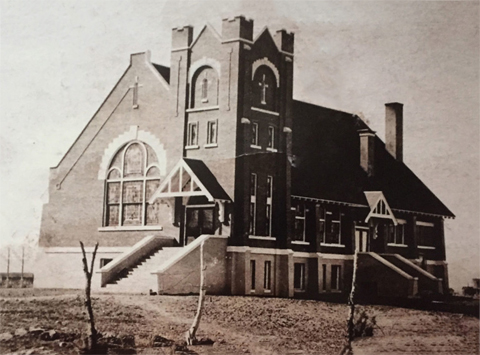
When the American Legion Memorial Building was dedicated 42 years ago, the community celebrated with two days of festivities – including a dedication address by Gov. C. Ben Ross, baseball games, a banquet, dances at LaGrande Hall, high divers making 100-foot dives, and carnival rides.
Today the Legion Building is still the site of banquets, meetings and parties – and the appearance of an Idaho governor, Malad’s John V. Evans is not unusual.
Renovation work on the sturdy red brick building was recently completed which will help keep it in shape to host many more future events. Remodeling work included pouring two new sets of cement steps to front and side entrances, building an enclosed basement entryway, boarding over and painting black the windows located on the second story and on the south side, repairing and repainting lower windows, and landscaping around the building. Hess Bros. Contractors did most of the work with volunteer Legionnaires doing the rest.
Other remodeling work planned or completed this year includes installation of a used stove and new ventilation hood, extensive painting of the interior, remodeling the gun room, wallpapering the refreshment area on the main floor, and carpeting the main meeting room.
The $5,000 cost of the renovation project will be met by local Legion and Auxiliary dues, reports Ernest W. Jones Post Commander T.D. Jones.
Headshot photo of Ernest W. Jones in his military uniform. Located in the center of the page (second column in the middle of the column).
Post Founded in 1919
Shortly after the completion of the National Organization of the American Legion in 1919, 15 Oneida men applied for a charter, which was granted by National Executive Committee action from temporary headquarters in New York City Nov. 5, 1919. Seeking applications were W. W. I veterans Dr. J.M. Kerns – who was later elected first Commander – R.G. Jones, Robert W. Bush, B.B. Jones, Lawrence Jones, Cornelius Jones, Alma Hanson, Alvin Thomas, Henry E. Jones, H.L. Herbert, D.L. Thomas, Walter M. Davis, Arthur B. Peck, Ebenezer M. Jones and William D. Clark.
The Post was named to honor Oneida County’s first casualty of World War I –
23-year-old Ernest W. Jones. Mr. Jones was serving with the 26th Infantry M.G. 1st Division when he was killed in action Oct. 9, 1918 in the Argonne Forest, France.
In 1921 the E.W. Jones Post purchased a lot from Fred Peck and nine years later on March 7, 1930, building operations were begun. The erection of the building was made possible largely by donated time and labor, with federal and State funds also contributing.
Milton T. Jones, who served as the Post’s third adjutant, can recall going house-to-house to raise funds for the Memorial Bldg. with chairmen assigned for each block to ensure complete coverage.
Dan W. Thomas, the Posts’ 17th Commander and presently serving as W.W.I Barracks Commander, recalls holding actions in front of the lot to sell a variety of donated items, including wheat, pigs and sheep. “The ladies worked real hard too, they sold a lot of quilts,” he noted.
Photo of 3 gentlemen standing in front of a building, one of them holding the glass door open. Caption says: Original American Legion charter members LeRoy Thomas, presently serving as World War I First Commander, left, and Dan Thomas vice commander, center, drop by the 42-year-old Legion Bldg. to survey recent remodeling under the direction of Ariel Jones, Post custodian. Photo by Kris Jones.
Auxiliary Charter
The Auxiliary was organized at a joint meeting of the Legion, War Mothers and eligible Auxiliary members. The charter was granted in February of 1925 with 31 members.
Dances were another popular way to raise money for the building, Mr. Thomas recalls.
Brothers Ted Jones and Ike Jones layed [laid] the brick and mortar, with Legionnaires hauling load after load of brick up from the depot. After five years of construction a July 15, 1935 dedication date was set with Gov. C. Ben Ross making the principal address. S.A. Hendricks, then president of the Malad Chamber of Commerce, gave welcoming remarks; and C.O. Nibert, Post Commander making the secondary address. The program included duets, readings and a selection by the High School band.
The celebration lasted two days – Main St. bustled with concession stands, carnival rides and novelty games, baseball matches were scheduled at the Public Square and banquets and dances filled the evenings.
A special attraction was the “skillful Otto who dives from a 100-foot ladder into a tank filled with just four and one-half feet of water.”
Bldg. Cost $30,000
According to an old Enterprise article, “The completed building has cost approximately $30,000 and has been constructed during the most trying time ever experienced in the financial world of America. The architect who designed the building said that it would stand the ravages of the elements for ages.”