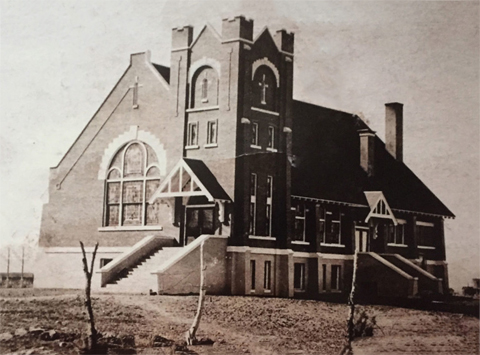
History of Firm, Founders Given As Bank Readies New Building
Page 2 – The Idaho Enterprise Thursday, August 9, 1962
Following is the concluding article of the series on the five founders of J. N. Ireland and Co., Bankers, in December, 1892. These were the pioneer financiers of this area whose foresight and zeal brought about the founding of what is now the oldest state chartered bank in the State of Idaho.
William G. Jenkins
W. G. Jenkins was the son of Griffith and Catherine Lelewellyn Jenkins. In Wales, when a child dies, they name the second boy the same name. So Mr. Jenkins was known as William (2) born May 24, 1850, at Penrhewer Farm Parrish [Parish] of Lontrisout. “The first William died when but 19 months old and the ‘second’ William was not long after born.”
Mr. Jenkins was one of the foremost financiers of his day. He was thrown upon his own resources when he was a mere boy. His mother died when he was two weeks old and his father died when he was 12 years old. He was thus forced to work and earn his livelihood at an early age. He secured employment with a Jew in a men’s furnishing store in Wales while he was living with an uncle.
When he was 18 years old, Bill Jenkins left Wales to join his sister, Mrs. Mary Jenkin Jones, in Malad. When he arrived in New York City and found that he had only $26 dollars in his pocket, he sought a job. He found work in the coal mines of Wilkes Barre, Pennsylvania, where he worked in the mines picking slate out of the coal before it was loaded on the cars. When he had earned enough money for the journey, he took the train to Corrinne, Utah, and came on to Malad where he lived with his brother-in-law and sister, Mr. and Mrs. Jenkin Jones.
Mr. Jenkins later went to Alta with two Welshmen from Malad to work in the mines. One winter there was a big snow slide and he helped dig out the other miners who had been trapped. He worked for a time in Park City, Utah, and then went to Bingham Canyon to work in the mines there. Four miners were batching and Mr. Jenkins assumed the responsibility of cooking the meals for his board and room.
John Stephens and W. G. Jenkins were freighting to Challis, Idaho, where they sold farm produce to the farmers and the miners. They both took up homesteads in Challis and Mr. Jenkins stayed there one summer working the land, but he soon sold out his homestead to John Stephens for $250.00.
Rich mining claims had been found in the Black Hills and Mr. Jenkins concluded to go there prospecting, but the military would not permit any other miners to go into that section because of the Indian uprisings so he came back to Malad.
Headshot black and white photo of William G. Jenkins. Located at the top paragraph, second row of the article.
He then went to work for the railroad at Bear Lake and put his team of horses on the pile driver on the bridge gang. He stayed with this work until they finished the railroad through to Pocatello. While they were working in the Portneuf Canyon he directed the Mormon Choir at McCammon. The railroad officials later took him off construction work and sent him to buy supplies and farm produce for the construction workers. He bought most of the butter and eggs from Mr. Fred Jones’ store in Malad and from the other farmers in this area.
On January 11, 1886 W. G. Jenkins married Eleanor Jones in Malad. She died on September 24 the following year and was buried at Malad. On April 17, 1889, he married Sarah Jane Jones in Malad; she died May 10, 1916.
In 1840, Washington Irving wrote that as far as he could see, the southeastern portion of what is now Idaho would always remain an arid desert through which travelers would struggle on their way to greener pastures. How wrong he was. Oneida County at that time extended to the Montana line and contained some of the historic spots and trails in Idaho.
The Utah Northern Railroad laid its rails to Oneida (Arimo) in Marsh Valley in 1874. At this time a great depression hit the country and the funds of the new railroad were depleted. After a time Jay Gould became the controlling stockholder and the government gave the railroad the necessary rights of way. Once again work commenced on the laying of tracks and the road was completed from Marsh Valley to Inkom.
In 1882 the narrow gauge track was changed to the standard width gauge to accommodate the heavier engines. At that time, Mr. Jenkins worked with other Malad men in furnishing ties for the railroad.
On July 30, 1885, Mr. Jenkins bought from A. W. Vanderwood the two acres of ground which the family currently owns south of the Deep Creek Bridge. The deed to this property recites that the groceries and liquors in the store on the property was transferred to W. G. Jenkins. The deed was witnessed by D. W. Standrod of the Territory of Idaho. The property consisted of a store, a saloon and brewery. Shortly after the purchase of the property, Mr. Jenkins went into the wholesale liquor business, purchasing the wines and liquors by car load lots. These were freighted up to Malad from Collinston, Utah. This immediate area was the central stopping point for all the freighters and Mr. Jenkins furnished the liquors for the freighters in 40-gallon barrels.
W. G. Jenkins was very friendly with the Indians in Washakie and for years during the deer season two of the Indians always came to him to borrow his rifle. He would also furnish them with a box of ammunition. In about six weeks they always brought the rifle back after the hunt.
President Joseph F. Smith and W. G. Jenkins were intimate friends as Mr. Jenkins had always banked with the Deseret National Bank in Salt Lake City. Often letters would come from President Smith asking that he call and see him when in Salt Lake City as President Smith always highly regarded his judgement in financial matters.
Many times when the federal officers were after the polygamists, Mr. Jenkins would sign their bonds as the federal men always accepted his signature as bondman for their appearance in court.
When the settlers of Stone, Idaho were about to lose their water rights to Utah, it was necessary to file a bond with the District Court, D. G. Nelson, a great friend, came over much worried and put his problem up to Mr. Jenkins. Together they went and talked this matter over with Dave (D. L.) Evans. Mr. Jenkins and Mr. Evans both signed the bond for $100,00.00 and Judge Budge accepted the bond. The case progressed and the settlers won their water rights.
In order to start the J. N. Ireland Bank, it was necessary to accumulate in cash the funds which the bank would initially have in its own safe. The $10,000.00 in gold which was used to open the bank was taken from her feather bed by Mrs. Jenkins in $20.00 gold pieces.
Adam Patterson, a great friend of Mr. Ireland and Mr. Jenkins was about to lose everything he had in Ogden, so he made the trip to Malad which took him four days to make the round trip. Mr. Jenkins counted him out three thousand dollars in gold coins to take back to Ogden to pay his debts.
In connection with the other men who founded the Ireland Bank, Mr. Jenkins was also active in the founding of W. G. Jenkins and Company, Bankers of Mackay, Idaho; the First National Bank of Arco, Arco, Idaho; the First National Bank of Pocatello, Pocatello, Idaho; D. W. Standrod and Company, Bankers, Blackfoot, Idaho; and the D. L. Evans & Company, Bankers, Albion, Idaho. He served as a director of each of the above banks and for eight years served as president of J. N. Ireland & Company, Bankers.
During the serious illness of Mrs. Jenkins at the Holy Cross Hospital in Salt Lake City in November, 1915, Mr. Jenkins sold the majority of his bank stock holdings and invested in stock of the Park, Utah Mining Company in Park City, Utah. His investment in these mines with Nate Rosenbaum proved exceedingly profitable for over 20 years. Mr. Jenkins and Mr. Rosenbaum were also principal stockholders in the Mackay Power Co.
Mr. Jenkins died in Malad on May 23, 1919.
Pioneer of Malad Valley Passes Away
William G. Jenkins Died Friday Evening After Very Brief Illness.
The funeral services over the remains of William G. Jenkins, who died at his home in this city Friday evening of last week, from an attack of pneumonia after a few days illness, were held at the family residence Monday afternoon. Rev. Williams presided at the services. Judge D. W. Standrod, of Pocatello, and R. J. Harding, of Malad, delivered addresses. Judge Standrod paid an eloquent tribute to Mr. Jenkins’ business ability and told of the lasting friendship between him and Mr. Jenkins. Mr. Harding pointed out the many ways in which Mr. Jenkins had aided in the upbuilding of this community. Both speakers highly eulogized Mr. Jenkins. A selection by an octet consisting of R. B. Davis, Earl Johnson, George Johnson, D. J. Reynolds, A. R. Castleton Jr., A. R. Castleston Sr., Morgan Tovey and Tom Williams, a solo by Miss Merle Thomas, and a solo by Arthur Castleton Jr. added to the impressiveness of the service.
There was a large attendance at the funeral, and the floral offerings were profuse and beautiful.
The pall bearers were Ed Vaughan, Tim Covert, Fred Peck, L. L. Evans, James Chivers and Hart Ezell.
Mr. Jenkins was a charter member of the local lodge of the Independent Order of Odd Fellows, and the members of that organization attended the services in a body.
The impressive burial ceremony of the order was used at the cemetery.
Wm. G. Jenkins was born at Glanmorganshire, South Wales, on April 29th. 1850. His mother died when he was two months old, and his father died when he was fourteen. He came to America when he was twenty-two years of age, located in Pennsylvania, where he worked in a coal mine for two years. In 1874 he came to Malad. From here he went to Dry Canyon, Utah and again engaged in mining.
A few years later he returned to Malad and since that time has made this his home. Like many of the early settlers, for a number of years he freighted from Corrine to points north of here. He was married to Miss Sarah Jane* Jones in 1889. (* Could be June).
Mr. Jenkins was frugal and industrious and soon became financially important in the community. As a banker he won a most worthy name. He was endowed with great ability as a financier, and was interested in a number of institutions in northern Utah and southeastern Idaho. He made a remarkable success and left a large estate.
Mr. Jenkins’ life was an example of what industry, thrift and wise management can accomplish in this land of opportunity. Coming to America without capital, he succeeded in accumulating a fortune.
He was a kind and loving husband and father; an upright and honest man.
Mr. Jenkins is survived by one sister, Mrs. Jenkin Jones, of Malad, two brothers, Evan and Morgan, who live in Australia, one daughter, Cassie, and three sons, G. L., McKinley and Nat.
Among those from out of town who attended the funeral were Mrs. Oscar Jones, of Pocatello; Mrs. W. P. Hayes of Salt Lake; D. C. McDougal, of Pocatello, L. L. Evans, of American Falls, and Judge Standrod of Pocatello.